

Sewage coming up through a floor drain or a toilet that will not stop backing up is an emergency, and our 24/7 dispatch line takes those calls at any hour. While you wait, stop using every fixture, keep children and pets out of the water, and do not open the main cleanout cap if wastewater is already rising.
Sewer line repair in Westfield, NJ means fixing the buried pipe that carries waste from your house toward the municipal sewer. The fix can be a short spot repair, a trenchless liner, or a full replacement, and the right one depends on what the pipe looks like inside. We start with a camera, because guessing at a buried pipe costs more than looking.
Sewer backup symptoms that point to the line, not a fixture
A single clogged sink is a drain job. These signs suggest the buried line itself is the problem.
Floor drain or basement shower bubbles
Wastewater finds the lowest opening in the house. When it shows there, the blockage or break is downstream of every branch.
Toilets gurgle when the washer drains
Air and water are being pushed back through a restriction in the main line.
Cleared once, back in days
A line that clogs again quickly may have a bellied section, offset joint or root intrusion holding waste.
Wet or sunken spot in the yard
Soggy ground or a depression over the path of the line can mean a leak or a collapse. Call 811 before any digging.
Sewer smell outdoors or in the basement
A cracked or open joint lets gas and wastewater out. Treat a persistent odor as a reason to inspect.
Which repair fits which finding
This is the decision frame we use after the camera has run the length of the line.
| What the camera finds | Likely repair | Why |
|---|---|---|
| One cracked joint or a short offset | Spot repair | The rest of the pipe is sound, so replace only the failed section |
| Roots in several joints, pipe otherwise intact | Trenchless lining, or cut and repair | Lining seals joints from inside and leaves the roots no way in |
| Long run of scale or pitting in cast iron | Lining or replacement | A liner can restore the bore if the pipe holds its shape |
| Collapsed or crushed section | Dig and replace that section | A liner needs a pipe it can pass through |
| Belly holding waste | Replace the sagged run | A liner follows the dip, so the low spot remains |
| Many failures along the whole line | Full replacement | Repeated spot repairs add up and still leave weak pipe |
The camera does not make the decision for you. It gives you the evidence to make it.
Sewage in the basement?
Stay out of the water, stop using plumbing and call the dispatch line.
Spot repair or replacement: how to weigh it
A spot repair is the right call when damage is limited and the rest of the pipe is solid. Cutting out a short section and joining new pipe on both sides is a small excavation and a short job. Trouble comes when the next failure is a few feet away, and the yard gets dug twice.
Replacement costs more up front and makes sense when the pipe is failing along its length. If the camera shows repeated cracks, heavy scale or multiple offsets, a patch only moves the problem. We tell you which side of that line your pipe is on, even if the answer is the smaller job.
Pipe lining and trenchless repair: what it is and where it stops
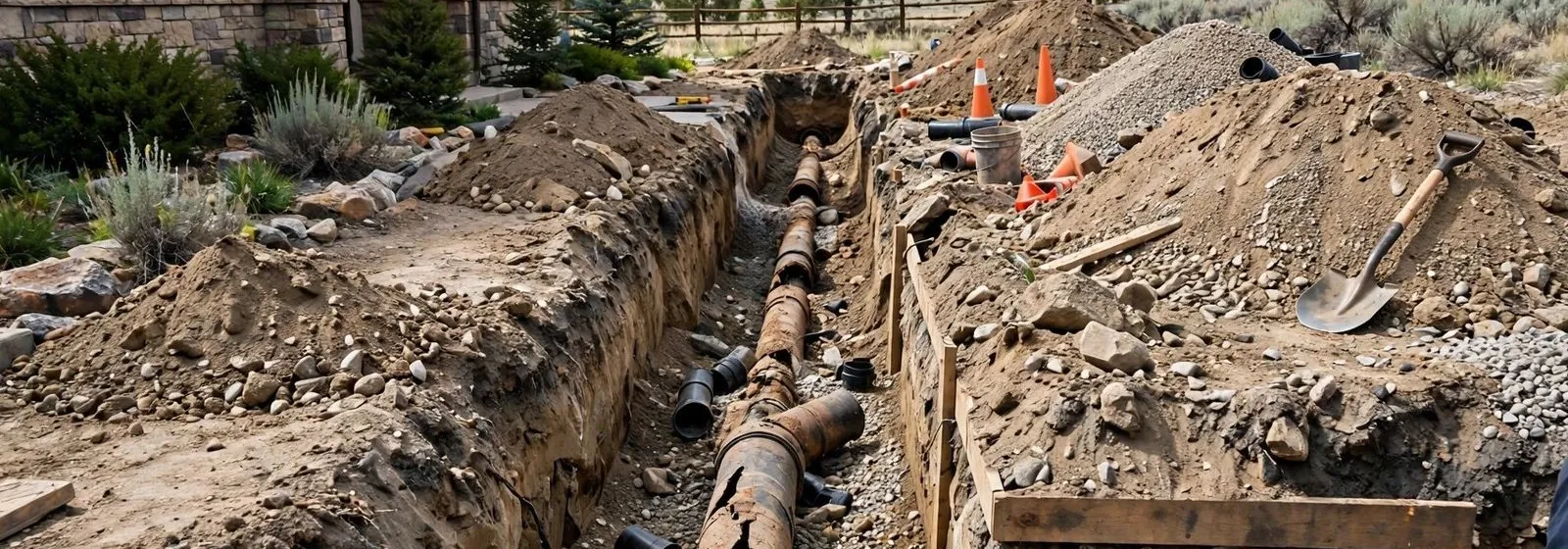
Trenchless lining pulls a resin-soaked felt tube into the old pipe and cures it in place, creating a new pipe inside the old one. It avoids a long trench through the lawn, driveway or garden. It is a strong fit for root-prone joints and pipe that is cracked but has held its shape.
It cannot pass a collapsed pipe, and it does not remove a belly, because the liner follows the old shape. It also reduces the pipe's inside diameter slightly, and the cleaned line must be prepared first, often with hydro jetting. Whether lining fits your line is a question the camera answers, not the sales pitch.
Cast iron pipe repair
Roughly two in three homes in ZIP 07090 were built before 1960, and cast iron was common in that era. Over decades it rusts from the inside into rough tubercles that snag paper and grease, and the pipe wall thins at the bottom where waste sits. A cast iron pipe can look fine from outside and be nearly closed inside.
Repair options are cleaning and relining if the wall is thick enough, replacing failed sections with plastic pipe, or replacing the run. We tap the pipe, look at the wall in the camera view, and tell you which condition applies. Cast iron inside a house is often easier to reach than a buried line, which affects cost.
Root intrusion: why it keeps coming back
Roots do not break good pipe. They find a joint that seeps, enter as hair-thin fibers and thicken into mats that catch every roll of paper. Cutting them clears the line and leaves the leak.
That is why we separate the two jobs: removing the roots for relief now, then repairing or lining the joint so they cannot return. If you only cut roots, expect them back. If you have seen roots return before, mention it when you call us, and we will say how fast they are likely to come back based on the camera.
What the town's own sewer work tells a homeowner
At an August 2022 council meeting, the town took up Public Works buying a sewer camera to inspect drains, along with an emergency repair of the Tamaques Way sewer pumping station. Public sewer pipes and pumps get inspected and repaired too, so a backup does not always start inside your property line. If your backup involves the section near the street, ask Westfield Public Works which section of the line is the town's.
About 37% of homes in ZIP 07090 were built in 1939 or earlier, with a median year built of about 1953. Pre-war houses can carry cast iron or clay lines, so a repair decision there deserves a camera first. We do not guess at material from a street name.
Source type: municipal council coverage (Patch recap of August 2022 council meeting) and Census ACS housing data
Sewage backing up right now: what to do before we arrive
Wastewater carries bacteria, so the goal is to limit water in and people out.
Stop using plumbing
No flushing, showers, laundry or dishwasher. Every gallon you add has to come up somewhere.
Keep out of the water
Keep children and pets away. Wear boots and gloves if you must cross a wet floor, and do not touch outlets or appliances in standing water.
Do not open the cleanout while it is rising
A cap under pressure can release a surge of wastewater. Leave it closed unless we ask you to open it.
Photograph and note
Take pictures of the backup and note when it started. They help us and any insurance claim.
From the first camera run to a repaired line
- 1
Camera and locate
A push camera runs the line from the cleanout while a locator marks the pipe at the surface, so we know depth and path.
- 2
Call 811 and check permits
Call 811 before any digging. Permit rules vary by job, so ask the Westfield construction office before work starts.
- 3
Clean the line
Roots and debris come out first so the repair meets clean pipe.
- 4
Repair or line
A spot repair is a small excavation with new pipe joined at both ends. Lining is pulled and cured in place.
- 5
Test and re-camera
We run water through and put the camera back in to confirm the joints are tight and the grade is right.
What shapes the cost of sewer line repair
Sewer work has the widest cost swing of any plumbing job, so a figure over the phone would be a guess. You get a clear price before work starts, and the dispatch line can book same-day appointments when available.
- Depth and path of the pipeA shallow run under lawn is simpler than a deep one under a driveway, porch or tree.
- Length of the damaged sectionA few feet is a spot repair, and a whole run is a different job.
- Repair methodLining, excavation and replacement each use different labor and materials.
- Surface restorationConcrete, pavers and landscaping that must be removed and replaced add to the job.
- Pipe material and fittingsCast iron, clay and plastic joined together need adapters and care.
Homeowners policies often cover sudden accidental discharge but not wear, corrosion or slow seepage, and a slow-failing sewer line is usually the second kind. Read your policy and ask whether sewer backup coverage was added. Call the dispatch line and we will explain what the camera footage shows in plain terms.
Standards and permits
New Jersey's plumbing subcode (N.J.A.C. 5:23-3.15) adopts the 2021 National Standard Plumbing Code, and repairs are done to it. Permit rules vary by job, so ask the Westfield construction office before work starts.
Sewer line repair questions
Yes. The dispatch line is open 24/7. Overnight we focus on stopping the backup and finding the cause, and a planned repair is scheduled once the camera shows what is needed.
No. It is a good fit for cracked pipe that holds its shape and root-prone joints. A collapsed or bellied pipe has to be dug and replaced.
A clog clears with cabling and stays clear. A broken line backs up again quickly and often shows roots, an offset or a belly on camera.
That is a question for Westfield Public Works, because we cannot say where the town's section ends and yours begins. Ask them which section of the line is the town's before you dig.
Either, depending on wall thickness and shape. We look at the pipe on camera and tell you if lining, section replacement or a full run replacement fits.
Lining and spot repair keep the dig small. Full replacement may need a trench, and we explain before work starts what would be removed and restored.
Yes. Our dispatch area runs from Westfield out through Scotch Plains and nearby boroughs. For a planned look at a line, see our sewer camera inspection page.