

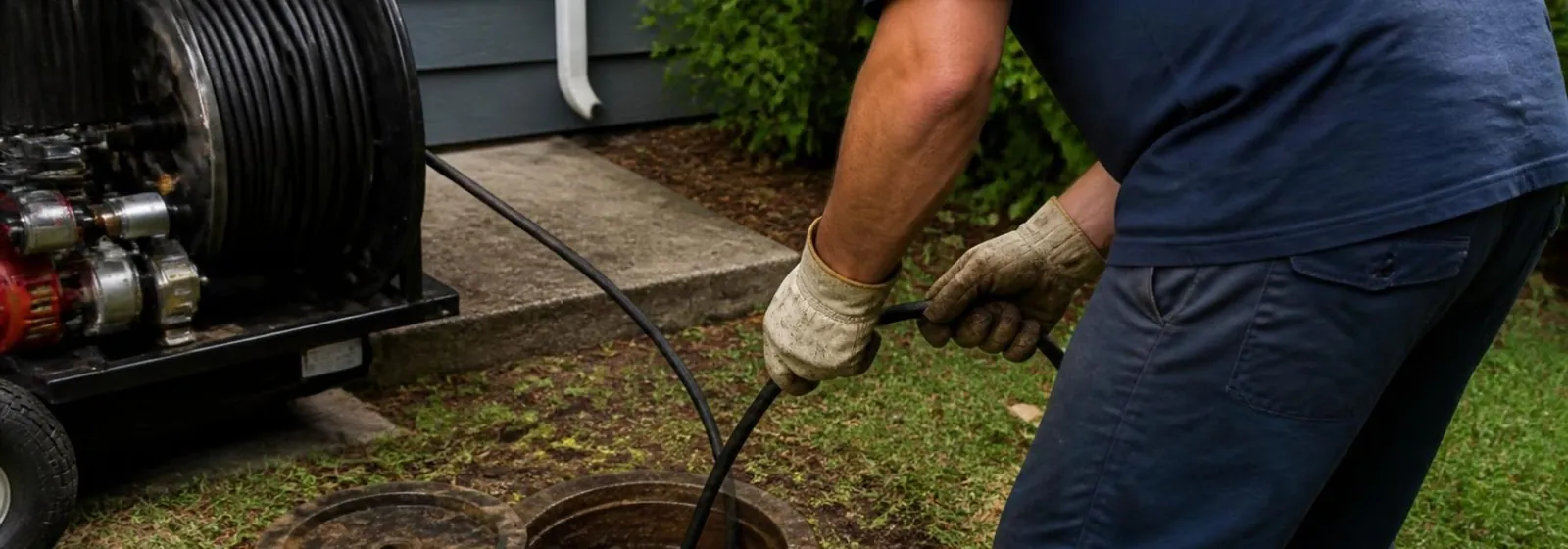
A main line stoppage turns every fixture in the house into an overflow, and the water goes to the lowest opening. Westfield 24/7 Plumbing keeps its dispatch line open 24/7 for exactly this call. Until we reach you, stop using water, leave the washer and dishwasher alone, and keep people away from any floor drain that is rising.
Sewer line cleaning in Westfield, NJ is the clearing of the main drain that carries all of your household waste from the house to the municipal sewer. It is done through a cleanout with a heavy cable machine or a water jet, depending on what is blocking the pipe. The goal is to restore full flow, not just to open a hole.
Main line backed up right now: your first response
The next ten minutes decide whether you have a nuisance or a flooded basement.
Stop every source of water
Shut off the washer, hold the dishwasher and ask everyone not to flush or shower.
Check the lowest drains
Look at the basement floor drain and the laundry tub. If water is coming up, move belongings and photograph it.
Locate the cleanout
Find the capped fitting near the foundation or in the basement. Clear a space and do not open it while the line is full.
Stay out of wet areas with power
Do not touch outlets, a water heater base or a furnace while standing in water. If water reaches electrical equipment, leave and call.
Is it the main line? Signs that point past the branch drains
Floor drain backs up first
The lowest drain is the first relief valve. If it overflows, the main line is carrying nothing.
A toilet bubbles when the tub drains
Air displaced by the draining water cannot leave through the blocked main.
Several fixtures slow at once
A sink, tub and toilet slowing together points past all the branches.
Backup stops when you stop water
A partial stoppage may hold until you add load, then back up on laundry day.
Gurgling at an outdoor cleanout
Sounds from an outdoor cleanout can mean the stoppage lies farther along the line.
Floor drain gurgling?
That is often the first sign of a main line stoppage. Stop the water and call.
Cleanout access: the cap that decides how the job goes
A cleanout is a capped fitting on the main line, usually a four-inch opening near the foundation, in a basement, or in a utility corner. With one, we can feed a cable straight into the line in minutes of setup, and we know exactly where we entered. Without one, we go through a toilet flange or a roof vent, which takes longer and costs more.
If you cannot find a cleanout, tell the dispatcher when you call. We will check the basement wall by the main stack, the garage and the outside of the foundation. Houses without a cleanout are a good candidate for adding one during the visit, because it makes every future cleaning cheaper.
Cabling or jetting a main line: the cleaner's view
Heavy cable machine
- Cuts through roots, rags and packed paper
- Reaches long runs and works around bends
- Leaves some coating on the pipe wall
- Chosen first for most main line stoppages
- Pairs well with a camera pass after
Water jet
- Scours grease, scale and silt from the whole wall
- Better for repeat stoppages
- Needs a pipe that can take the pressure
- Carries debris out of the line instead of leaving it
- Often follows a cable pass for a cleaner result
How a main line gets cleared, from cleanout to curb
- 1
Open the cleanout carefully
We stand clear and open the cap slowly, since a full line may release water. A bucket and a drain pan catch the first flow.
- 2
Feed the machine
We run the cable in and read the resistance. A soft spot feels different from roots or a hard obstruction.
- 3
Cut and flush
Roots are cut with a blade head. Packed paper is broken up and washed through by running water into the line.
- 4
Pull a sample
What is on the cable tells us if the cause was grease, roots, a toy or a collapsed section.
- 5
Run water and test
We run fixtures and watch the cleanout for steady flow. If the water slows again, we know the problem is not fully cleared.
Floor drains and basement backups
A floor drain usually ties into the line below the level of every fixture above it. That makes it the first place wastewater appears during a main line stoppage. A floor drain with a dry trap also lets sewer gas up, so a smell can appear before a backup does.
After the line is clear, we run water down the floor drain to confirm it flows and refill the trap. If the drain backed up, clean and dry the area quickly, and wear gloves and boots. Ask us about the condition of the floor drain on the same visit.
Heavy rain, flooded streets and your sewer line
In a July 2025 storm, the Westfield area got more than six inches of rain by 8 p.m. according to the National Weather Service, with up to 2.07 inches per hour in Union County. Tropical Storm Ida in 2021 brought catastrophic flooding to Westfield. Rain that heavy loads drains and sewers, and a basement floor drain is often the first place a stressed system shows it.
Westfield's sewer system connects to the Rahway Valley Sewerage Authority (RVSA). If you get a backup during or just after a storm and a neighbor does too, a clog in your own pipe may not be the cause. Call us anyway, because we can tell on site whether your line is clear, and ask Westfield Public Works which section of the line is the town's.
Source type: newspaper coverage (The Leader, July 2025 and Feb 2024) and Patch recap of Ida coverage
What affects the cost of sewer line cleaning
We will not name a figure over the phone, since two main lines in one block can be very different jobs. You get a clear price before work starts, and same-day appointments are offered when the day has space.
- Cleanout or no cleanoutWith a cleanout we are working in minutes. Without one, access costs time.
- How far the blockage sitsA stoppage near the house is a short run. One near the street uses more cable and time.
- Cause of the stoppageRoots, grease, paper and foreign objects each call for a different head or a jetter.
- Cable or jetA jetting pass takes different equipment and more time than a cable pass.
- Time and dayOvernight and weekend visits depend on dispatch capacity.
Homeowners policies often cover sudden accidental discharge but not wear, corrosion or slow seepage, and sewer backup coverage is usually a separate endorsement. Read your policy, and photograph the damage before you clean. Our dispatch line can talk you through what to document.
Main sewer line questions
Yes. The line is open 24/7, including holidays. A backup in the middle of the night is treated as an emergency, and we will give you steps to follow until we arrive.
Not while the line is full. A pressurized cap can release a surge of wastewater. If you must, stand clear and open slowly with a bucket ready, or wait for us.
The basement has the lowest drains in the house, so wastewater rises there before it reaches an upstairs fixture.
We cannot tell you from the phone which section is whose. Ask Westfield Public Works which section of the line is the town's. We can check whether your side of the line is clear.
Then something in the pipe is holding the stoppage. A camera pass, as in our sewer inspection, will tell you whether it is roots, a belly or a break.
No. Cleaning clears debris. A collapsed or broken pipe needs sewer line repair.
Yes. Scotch Plains is part of our dispatch area, and a main line stoppage there is handled the same way as in town.