

A drain that backs up into the house cannot wait for a convenient week. Our 24/7 dispatch line takes jetting calls day and night. Until help arrives, stop using water and keep everyone off the lowest drains.
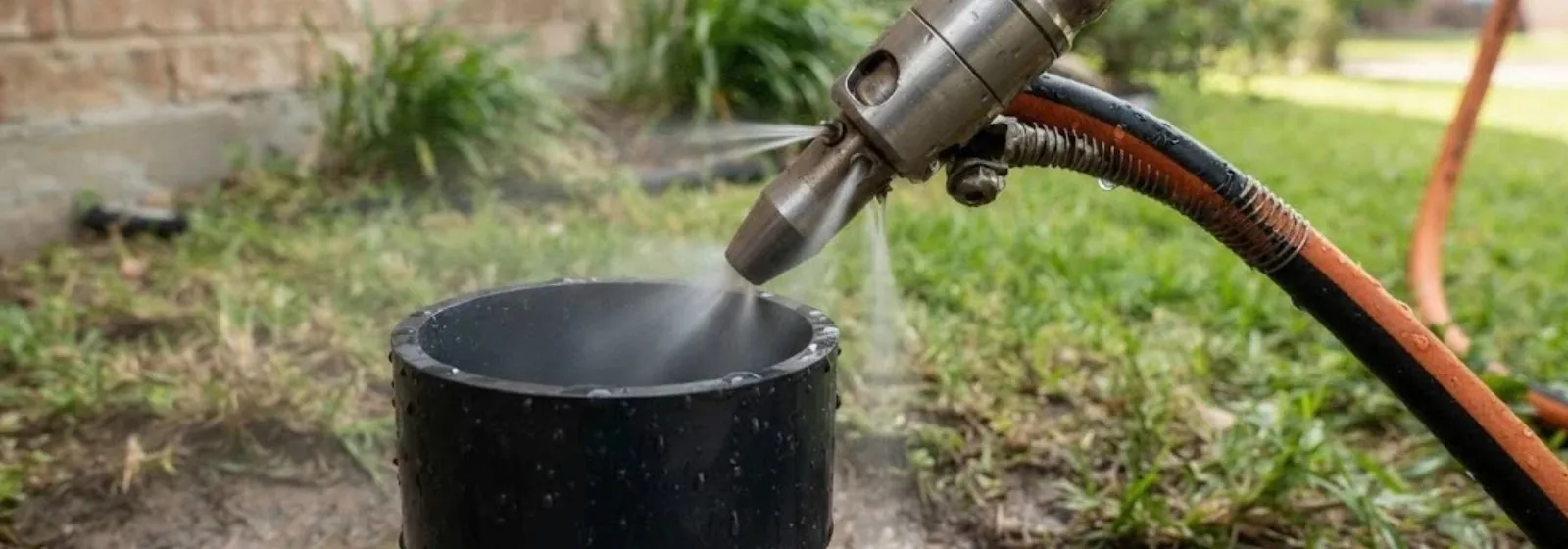
Hydro jetting in Westfield, NJ is the cleaning of a drain or sewer line with a high-pressure water hose and a nozzle that fires jets backward to scour the pipe wall and pull itself forward. It removes grease, soap scale, silt and small roots instead of poking a channel through them. It is a cleaning method, not a repair, and on old pipe it starts with a camera.
Cable or jet: what each one leaves behind
Cabling (snaking)
- Spins a cutting head through the clog and leaves a channel the width of the head
- Good for a fresh, soft or hair-and-paper stoppage
- Grease and scale stay stuck to the pipe wall
- Quick to set up and gentle on thin or fragile pipe
- The clog often returns in weeks if the wall stays coated
Hydro jetting
- Washes the full inside of the pipe with a rotating spray
- Good for grease, scale, silt and repeat clogs
- Carries debris downstream and out instead of leaving it
- Needs a clear path, a stable pipe and a camera look first
- Cannot fix a break, a collapse or a sag that holds water
What the water does to grease, roots and scale
Grease is the easiest to explain. The force of the spray breaks a thick wall of kitchen fat into pieces small enough to flush. A cable cannot do that, which is why a grease-lined kitchen drain gets better results from a jetting pass.
Roots enter a line through joints and hairline cracks and grow into dense mats. A nozzle with a forward-facing jet clears fine root hair and thinner strands, while the rotating spray scrubs the pipe wall behind it. The cut roots will regrow if the joint still leaks, so jetting buys time rather than ending the problem.
Scale is a mineral and rust crust on cast iron and galvanized steel. The spray knocks off loose scale and exposes the pipe underneath, and the flakes come out at the cleanout. If a lot of metal comes out, we say so and suggest a look at the wall thickness with the camera.
Line backing up again?
Repeat clogs are the classic jetting call. Tell us when it was last cleared.
Signs your line is a jetting job
These patterns point away from a one-time clog and toward buildup on the pipe wall.
The same drain clogs every few weeks
The wall coating is narrowing the pipe again after each cable pass.
Slow drains in more than one fixture
A partly narrowed branch or main line backs up under heavy use, like a laundry day.
Gurgling after a cable visit
Air is moving through a pipe that is still partly blocked.
Foul smell from a floor drain
Grease and silt rot in the pipe wall and in the trap seal.
Rust or root threads on a cable
The line has scale or a root problem that a cable only trims.
Sewer rates, an aging housing stock and the case for keeping a line clear
Westfield's sewer system connects to the Rahway Valley Sewerage Authority (RVSA), and in early 2024 the town introduced an ordinance on a new RVSA fee structure while sewer rates were rising. Jetting does nothing to those charges, and we do not claim it saves you money on them. The practical point is smaller: if you already pay to use the line, it makes sense to keep it open rather than pay again for a backup.
Roughly 37% of homes in ZIP 07090 were built in 1939 or earlier, and the median year built is about 1953. Lines from that era can be cast iron or galvanized, rough inside and prone to scale. That is why we put a camera in the pipe before we point a jetter at it.
Source type: newspaper coverage of town sewer ordinance (The Leader, Feb 2024) and Census ACS housing data
What the camera shows and what we do about it
Jetting is only the right call if the pipe can take it. The camera finds out first.
| What the camera shows | Jet it? | What happens next |
|---|---|---|
| Grease, silt or scale on intact walls | Yes | Jet in passes, then re-check the wall |
| Fine roots at a joint | Yes, with limits | Clear the roots, then watch the joint for regrowth |
| Large root mass pushing a joint apart | Cut first, not full pressure | Cut the mass, then plan a repair |
| Cracked or offset pipe | Not at full pressure | Advise a repair before cleaning |
| Collapsed section or a belly full of water | No | Water cannot move debris uphill, so repair or relining is the answer |
If the camera cannot pass an obstruction, we say what we could and could not see.
What jetting cannot fix
A bellied pipe is a section that has sunk and holds a pool of water and waste. Jetting can clean the belly but cannot lift it, so debris settles there again. A collapsed pipe is worse: the nozzle cannot pass and the water has nowhere to go.
Those findings move you to sewer line repair, which covers spot fixes, relining and replacement. If your last cleaning turned up a dip or a break, call the dispatch line and tell us what you saw. We would rather say a cleaning is short-term than sell one that cannot last.
Backed up right now? What to do before the jetter is set up
Jetting equipment needs a clear path and a calm work area. These steps help.
Stop all water use
No flushing, laundry or dishwasher cycles. Water you add will find the lowest drain and come up there.
Find the cleanout
A capped fitting near the foundation or the basement floor. Clear a four-foot area around it so the hose can be set up.
Move valuables from floor drains
Raise boxes, rugs and electronics off the basement floor. If water is already coming up, leave it for us to deal with and stay out of standing water near outlets.
Note what has been tried
Tell us if you used chemical cleaner or a plunger and when the line last had service. It changes the plan.
The jetting sequence, from camera to final check
- 1
Camera inspection
A push camera goes in through the cleanout so we can see wall condition, joints and the location of the blockage.
- 2
Select the nozzle
A cutting nozzle for roots, a rotating scouring nozzle for grease and scale, and a penetrating nozzle for a hard plug.
- 3
Set pressure in stages
We start low and raise it as the pipe allows. Old or thin pipe gets a gentler pass.
- 4
Run in both directions
The nozzle advances with the hose, then is pulled back at a slower pace so it scrubs the walls on the return.
- 5
Re-inspect and test
A second camera pass confirms the wall is clean and water runs freely, and we run fixtures to test the flow.
What drives the price of a jetting visit
We will not quote a figure without knowing the line, and you get a clear price before work starts. Same-day appointments are scheduled when the day has room, and the dispatch line stays open all night.
- Length and size of the lineLonger runs and larger pipe need more hose, more water and more time on site.
- Camera findingsA clean wall is quick. Heavy scale, roots or an offset joint call for slower passes.
- AccessA good cleanout makes the work straightforward. A line with no cleanout means more setup.
- Type and amount of buildupSoft grease, packed roots and old scale respond differently and take different time.
- Time of the callA late-night or holiday visit is scheduled around dispatch capacity.
Homeowners policies often cover sudden accidental discharge but not wear, corrosion or slow seepage, and root-related damage is frequently treated as maintenance. Read your policy and ask your insurer before assuming coverage. When you call the jetting line we can describe what we find in terms an adjuster can follow.
Hydro jetting questions we hear
Yes. Our dispatch line runs 24/7, and a backup in the middle of the night is handled as an emergency. Same-day scheduling is offered when a slot opens.
Because we put a camera in before the jetter, an overnight call may start with a quick look rather than full pressure.
It can be, when the pipe is sound. That is why we scope first. A line with cracks, offsets or thin walls gets gentler pressure or a repair recommendation before cleaning.
A cable opens a channel through the clog but leaves the coating on the wall. If the same line has backed up more than once, a jetting pass cleans the pipe itself.
No. It clears roots from the pipe, but roots regrow if a joint still leaks. A camera inspection helps decide whether repair is the longer-term fix.
On sound pipe at the right pressure, no. The risk is with already-damaged or very thin pipe, which is why we look first and keep pressure staged.
It depends on what built up and why. A kitchen line with heavy grease may need a regular schedule, and a root-prone line may need it more often until the joint is repaired. We cannot give a fixed interval without seeing the pipe.
Yes. Calls from Scotch Plains and the boroughs around Westfield come through the same dispatch line.