

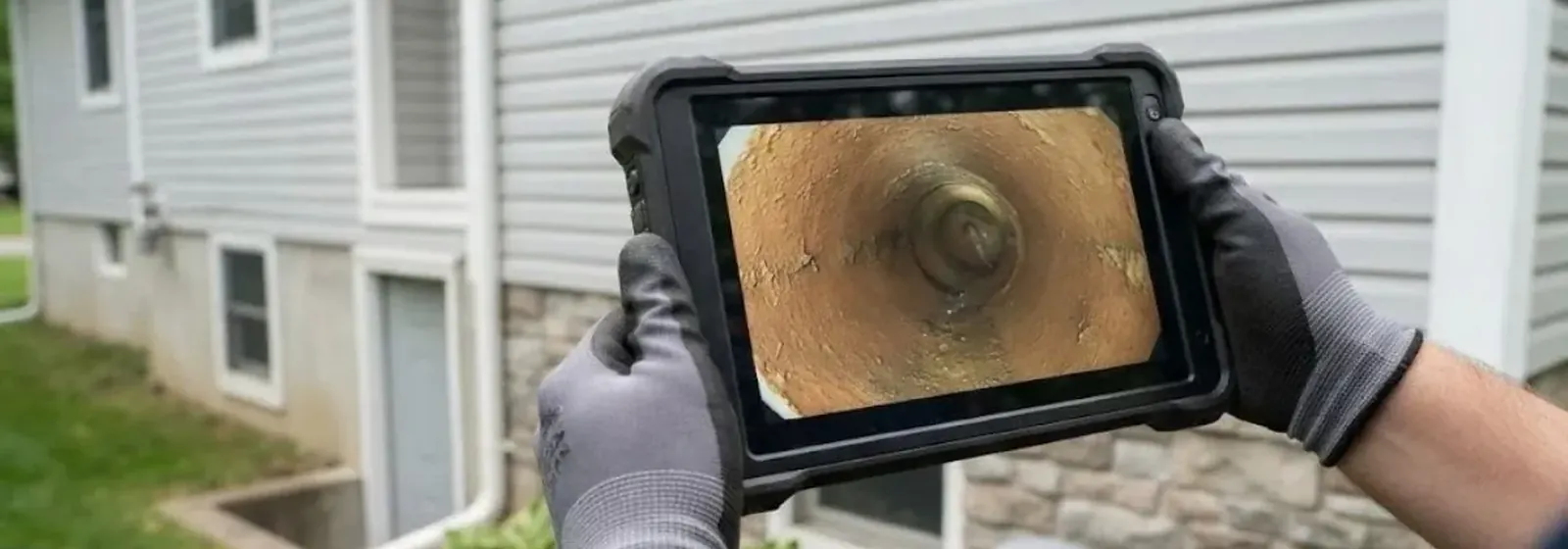
A sewer camera inspection in Westfield, NJ is a recorded look inside the pipe between your house and the street, made by pushing a waterproof camera head down the line from a cleanout. It shows the pipe material, joints, cracks, roots, sags and buildup as they are today. The footage becomes the evidence for what, if anything, needs doing.
It is the quiet job on our list. You schedule it before a closing, after a pattern of clogs, or when you want a baseline on an older home. Urgent backups are handled by our 24/7 dispatch line, but a planned inspection can usually be booked for a day that suits you.
What you get: footage, a location and a plain-English read
You are not paying for a walk around the basement. You are paying for a video of the inside of the pipe, a mark on the ground showing where the problem sits and how deep, and an explanation of what it means. If the camera finds nothing, that is a useful result too.
When a camera inspection makes sense
These are the situations where we most often suggest putting a camera in the line.
- Before you buy a house, especially one built before 1960
- A clog that returns after cabling or jetting
- A backup after a heavy storm or flooding event
- Gurgling in the lowest drains or a sewer smell in the basement
- Planning a tree planting, driveway, or addition near the line
- A slow drain on the main line with no visible cause
- After a repair or lining job, to confirm the work
Buying a house?
Ask for the line to be scoped before closing, not after.
How the inspection goes on site
- 1
Locate the access
We find the cleanout, or pull a toilet or open a vent if there is none. We tell you which before we begin.
- 2
Feed the camera
The head is pushed down the line on a flexible rod, with lights and a cable that measures how far it has travelled.
- 3
Watch and record
We watch the live feed, note distances to each feature and save the video.
- 4
Locate and mark
A transmitter in the camera head lets a receiver above ground find the exact spot and depth. We mark the ground or note landmarks.
- 5
Walk through the findings
We review the footage with you and give you the distances, depths and what each finding means.
What shows on the screen and what it means
Each finding below has a typical meaning and a typical next step. The footage tells you which applies.
| On screen | What it means | Usual next step |
|---|---|---|
| Smooth wall, clean joints | The pipe is in good shape | Keep records for your baseline |
| Grease or scale buildup | Narrowed bore from deposits | Cleaning, sometimes by hydro jetting |
| Fine roots at a joint | A joint is seeping | Root cutting, then watch or repair |
| Offset or separated joint | Pipe sections have shifted | Spot repair or relining |
| Standing water in a dip | A belly where waste collects | Monitor or replace that section |
| Crushed or collapsed pipe | The pipe has failed | Excavation and repair |
We tell you what we see and what we cannot see.
A push camera: what it can and cannot show
What it shows
- Pipe material and joint style where visible
- Cracks, offsets, roots and scale on the walls
- Sags and bellies where water pools
- Distance and depth to each finding
- A recording you can keep and share
What it cannot do
- See through a fully blocked line (the line must be cleared first)
- Judge pipe strength from the video alone
- Show the whole house plumbing, only the line it travels
- Pass some tight bends or severely collapsed sections
- Tell you the cause of a problem without context from you
How to read a sewer camera report
A good report lists each finding with a distance from the cleanout, a short description and a still image or time stamp. Distances matter because they let a repair crew find the spot. Ask for the video file as well as the notes.
Not every finding is a repair. A few light roots at a joint or minor scale is a maintenance item. A crack with root intrusion, a clear offset or a belly with standing water is a decision point. If we cannot see a section, the report should say so, and you should ask what that section is likely to hold.
Pre-war houses and the town's own camera
In August 2022 the town council took up the purchase of a sewer camera for Public Works to inspect drains. Public Works looks inside drains with a camera, and you can do the same for the line that serves your house. Before planning work near the street end, ask Westfield Public Works which section is the town's.
About 37% of homes in ZIP 07090 were built in 1939 or earlier, with a median year built about 1953. A buyer of a pre-war house is inheriting a buried pipe that may not have been looked at in decades, and an inspection before closing is how you learn what you are inheriting. Bring the footage to the negotiation.
Source type: municipal council coverage (Patch recap of August 2022 meeting) and Census ACS housing data
What affects the cost of a camera inspection
We cannot name a number before seeing the access and the line length, and we give you a clear price before work starts. A call to the dispatch line gets you booked, and same-day appointments are available when the schedule allows.
- Access to the lineA cleanout makes the job quick. Pulling a toilet or opening a vent adds time.
- Length and bendsA longer run with several turns takes more time to travel and to record.
- Cleaning needed firstA line blocked with debris or grease has to be cleared before the camera can see it.
- Locating and markingFinding and marking a depth and a path across a yard adds time compared with a view-only run.
- Report detailA short verbal review is different from a written report with distances and stills.
Homeowners policies often cover sudden accidental discharge but not wear, corrosion or slow seepage, and an inspection itself is usually not a covered item. If you are filing a claim for a backup, the footage can document the condition, so read your policy first. To book, call (908) 357-1542.
Sewer inspection questions
Yes, especially in an older home. A standard home inspection does not usually run a camera down the buried line. Ask your agent whether an inspection contingency covers it.
No. It shows condition today. It cannot predict a date of failure, so we describe what we see and what the risks are.
We clear it first, usually with a cable or a jetting pass, and then run the camera. We will tell you before we start if cleaning is needed.
Yes. A transmitter in the camera head lets us find the line and depth from above ground. Call 811 before any digging.
Often yes. A one-off backup in heavy rain may not mean damage, but repeat backups or roots on camera do. A look tells you which.
Yes. If you have sewage coming up now, our emergency sewer line cleaning service is available 24/7. A planned inspection is the calmer option.
We do, including a planned inspection before a purchase. See our Scotch Plains service area.