

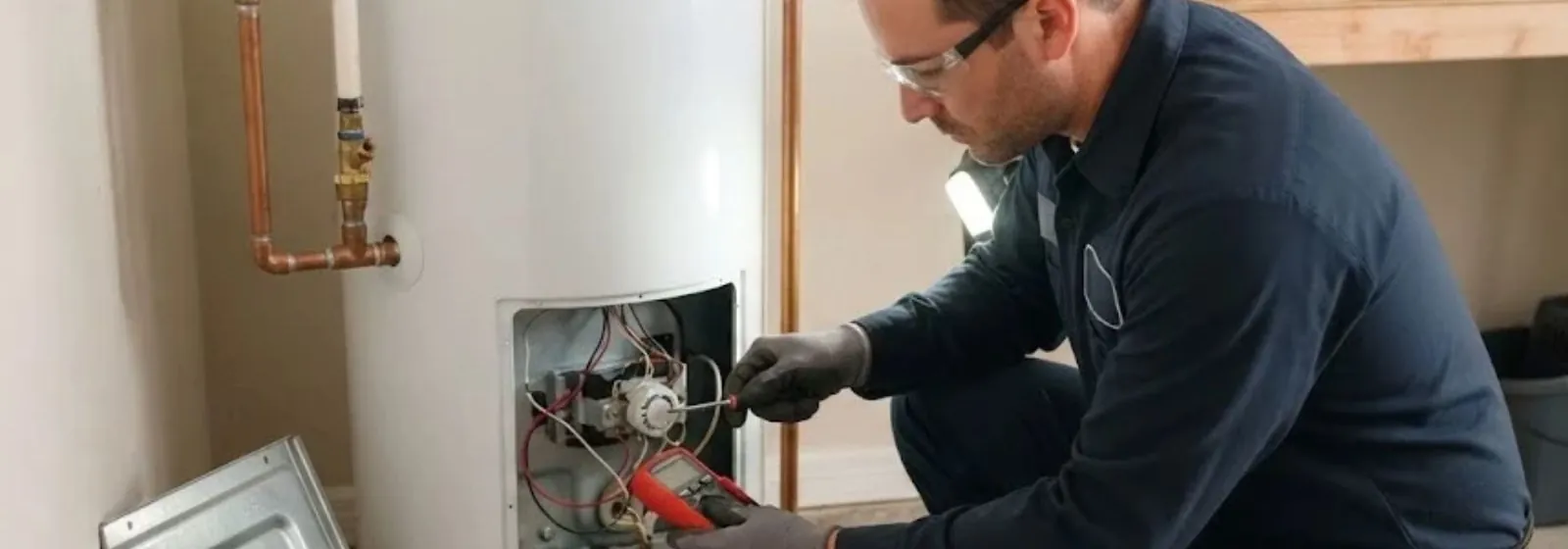
Water heater repair in Westfield, NJ means working out which part of a tank, burner, element, or valve has failed, then fixing that part instead of guessing. If water is spreading across the floor or the house has no hot water, we know it cannot wait. Our 24/7 dispatch line is open tonight, and while you wait you can close the cold water valve on top of the heater and cut its power or gas.
The symptom usually points straight at the cause. A pilot that will not stay lit is a different failure from a tank that rumbles, and neither one is a puddle at the base. Below you will find what each symptom means, what is safe to check yourself, and the point where repair stops making sense.
Smell gas or see water pouring? Do this right now
If you smell gas (a rotten egg odor) near the heater, do not touch a switch and do not hunt for the source. PSE&G's guidance is to leave the building immediately, move at least 350 feet away, and then call 1-800-880-PSEG (7734) or 911. Do not use a light switch, doorbell, matches, appliances, or a phone inside, and do not start a car.
Call us only after PSE&G or the fire department has cleared the house. Gas leaks are theirs to find and shut down, not ours. If the emergency is water instead, a tank pouring from the base or a split fitting, close the cold supply valve, cut the power or gas, and then call.
No hot water, lukewarm water, or odd noises: what each one means
Most callers describe what they see or hear, not the part name. Here is how the common complaints map to causes.
No hot water at all
On a gas unit, think pilot, thermocouple, or gas control valve. On an electric unit, think tripped breaker, tripped high-limit reset, or a dead element.
Hot for a few minutes, then cold
A cracked dip tube sends incoming cold water straight to the outlet. A single failed element in an electric tank gives the same short supply.
Water around the base
It may be condensation, a weeping fitting, a dripping relief valve, or the tank itself. Only the tank itself is a replacement.
Rumbling or popping
Sediment collects on the bottom, traps water under it, and the water flashes to steam. The noise is the tank telling you it is overworked.
Rotten egg smell from hot taps only
If cold water smells fine, bacteria reacting with the anode rod is the usual suspect. This is not the gas smell, but if you are unsure, treat it as gas.
Scalding water
A stuck thermostat or a failed gas control can overheat the tank. Turn the heater off and keep children away from the taps until it is checked.
Tank leaking right now?
Close the cold supply valve above the heater, then call.
While you wait: four moves that limit the damage
These take about two minutes and make the visit shorter.
Close the cold inlet
Find the valve on the pipe feeding the top of the tank and turn it clockwise until it stops. If it will not move, shut the main where water enters the house.
Cut power or gas
For electric, switch off the dedicated breaker. For gas, turn the control to OFF only if you smell no gas. Never relight a pilot in a room that smells like gas.
Leave a hot tank alone
Do not open the drain valve on a tank that has just been running. The water inside can scald, and the hose can melt.
Photograph the rating label
The label on the side lists fuel type, capacity, and model. With that photo we arrive knowing what parts and fittings the tank takes.
Symptom, likely cause, and the usual fix
This is a starting map, not a diagnosis. A meter reading or a flame check can change the answer.
| Symptom | Likely cause | Typical repair |
|---|---|---|
| Pilot goes out after a few minutes | Worn thermocouple or thermopile, or a draft pushing the flame | Replace the sensor, clean the pilot tube, check venting |
| Electric tank, no heat at all | Tripped high-limit reset, bad upper thermostat, burned element | Test with a meter, replace the failed part |
| Lukewarm and short supply | Broken dip tube, failed lower element, heavy sediment | Replace dip tube or element, flush the tank |
| Drip from the relief valve | Thermal expansion pressure, worn valve seat | Test the valve, add or recharge an expansion tank |
| Water at the drain valve | Loose or cracked plastic drain valve | Replace with a brass valve |
| Water seeping from the tank seam | Corroded steel, anode rod long gone | Replace the tank, no repair exists |
Final answers depend on testing the unit in place.
Gas, electric, and heat pump heaters break in different places
A gas tank is a burner under a water vessel. The parts that fail are the thermocouple that proves the pilot is lit, the gas control valve with its thermostat, and the flue that carries exhaust out. A weak draft or a blocked flue can snuff the flame or spill exhaust into the room, so we check the draft before we declare the burner fixed.
An electric tank has two heating elements, a thermostat for each, and a high-limit safety reset. Elements burn out, thermostats stick, and a tripped breaker may point to a grounded element rather than a nuisance. We meter the circuit before touching anything, because the tank is fed by 240 volts.
A hybrid heat pump heater adds a compressor, a fan, an evaporator coil, and a condensate drain. The common faults are a clogged air filter, a blocked condensate line that leaks onto the floor, and an error code that forces it into slower element-only mode. If the compressor itself has failed, the repair conversation is about warranty and age, not parts.
A dripping relief valve is a warning, not an annoyance
The temperature and pressure relief valve is the last safety device on the tank. When it drips, one of two things is true. Either the valve is worn and leaking by, or the water is getting too hot or the pressure is climbing, and the valve is doing its job.
Many houses have a check valve or pressure reducing valve on the incoming line, which turns the plumbing into a closed system. Heating water expands, and with nowhere to go, pressure spikes every cycle. An expansion tank fixes that. Replacing the valve alone just hides the symptom until it drips again, so we read the pressure at a hose bib first.
Never cap or plug a relief valve. If you want the drip out of the room until we arrive, leave the discharge pipe open and put a bucket under it. A capped valve on a hot tank is a pressure vessel with no exit.
Relief valves and their discharge lines fall under the plumbing code that applies in your town. New Jersey's plumbing subcode adopts the 2021 National Standard Plumbing Code. We follow it and the maker's instructions when a valve has to be replaced.
Fix it or replace it: how we decide
Repair usually makes sense
- The leak is at a fitting, drain valve, or relief valve, not the tank body
- A thermocouple, element, thermostat, or gas valve has failed on a tank in decent shape
- The tank is not near the end of its service life and the interior is not shedding flakes of sediment
- The anode rod can still be reached and replaced
- You can live without hot water for the time the part takes to arrive
Replacement usually makes sense
- Water is weeping from the seam or bottom of the tank itself
- The tank is old, and the repair would be the second or third in a short time
- Rust-colored water comes only from the hot side
- The repair costs a large share of a new unit and does not extend the tank's life
- You want to move to a different fuel or a heat pump model, see replacing the tank outright
What happens after we arrive
This is how a repair call runs, and it stops early if the tank itself is the problem. If you are unsure at any point, call the dispatch line and describe what you see.
- 1
Make it safe
We check for gas smell, scald temperature, and standing water near electrical parts before any panel comes off.
- 2
Read the label and the history
Fuel, capacity, and installation age tell us which parts to expect, and what you remember about the failure narrows the search.
- 3
Test, do not guess
A multimeter on the elements and thermostats, a manometer or leak solution on gas connections, a pressure gauge on a hose bib, and a flashlight at the flue.
- 4
Quote the repair or the swap
You hear the finding, the options, and the price before we start any work. If the answer is a new tank, we say so.
- 5
Repair, then verify
After the part goes in we run a full heat cycle, watch the flame or draw, check the relief valve, and confirm the water temperature at a tap.
Older Westfield basements and the gas side of the job
About 37% of homes in ZIP 07090 were built in 1939 or earlier, and the median build year is about 1953. Houses from that era often have a heater that vents into an old masonry chimney. A cold, oversized flue can let exhaust drift back into the room instead of rising, so ask us to check the draft after any burner repair.
PSE&G serves gas customers in town, so any gas smell goes to them before it comes to us. A pilot that keeps going out is not a leak, but if you smell gas at any moment while relighting, stop, leave, and follow the 350 feet step above. If a chimney-vented tank keeps failing, a tankless unit with its own sealed vent is one alternative worth pricing.
Source type: Census ACS housing data and PSE&G customer safety guidance
What drives the cost of a water heater repair
We cannot give a number before we see the unit, and any company that does is guessing. What we can do is name the factors, then quote a clear price before work starts. If your problem looks like one in the table, we will say what to expect for your type of heater once we have looked.
- The failed partA thermocouple is a small job. A gas control valve, a heat pump compressor, or a full element set is a bigger one.
- Fuel type and accessA heater wedged behind a furnace or under stairs takes longer to work on than one in the open.
- Age of the tankOlder steel can fail again within months, which changes whether a repair is sensible.
- Code and safety fixesA rusted relief discharge pipe, a missing drain pan, or a flue that needs rework gets added to the visit.
- After-hours timingNight, weekend, and holiday visits are priced differently from a planned daytime appointment.
Homeowners policies often cover sudden accidental discharge from a failed water heater but not wear, corrosion, or slow seepage over time, so read your policy and call your insurer if the leak did damage. Take photos before you clean up. If the heater is still working but worrying you, call the dispatch line and describe the symptom.
Water heater repair questions we hear in Westfield
Yes. Nights, weekends, and holidays are covered, and we book same-day appointments when available. Say whether water is leaking, whether the tank is gas or electric, and what you have already shut off, and we can plan the visit.
If you smell gas, leave and call PSE&G or 911 before you call us.
If there is no gas smell and the manual for your tank describes the steps, relighting once is reasonable. If it dies again within a day, the thermocouple, a draft problem, or a dirty pilot tube is the cause and relighting repeatedly only hides it.
Never relight if you smell gas. Leave the building and call PSE&G.
Sediment on the tank floor traps water that boils underneath it. The noise gets worse as the layer thickens, and the layer wastes fuel because heat has to pass through it. A flush sometimes helps, and sometimes a tank that old will leak after the sediment is disturbed.
Rarely, but treat it seriously. A drip usually means thermal expansion pressure or a worn valve. We read the water pressure and the thermostat setting before touching the valve.
Do not cap the discharge pipe.
It depends on where the water is coming from. A leaking fitting, drain valve, or relief valve is fixable. A tank that weeps from the body is finished, and no repair stops it.
Age matters too. If a repair has been repeated in a short span, a new tank is usually the better use of money.
Yes. Elements, thermostats, and high-limit resets are routine. Heat pump models get filter, condensate, and fan checks, and if the compressor or sealed system is the fault we tell you plainly whether it is worth pursuing. If a different heater type is on your mind, see installing a new unit in a new spot.
Yes, we serve Westfield and nearby towns, including Scotch Plains, Cranford, Garwood, and Mountainside. For Scotch Plains specifically, see our Scotch Plains emergency plumbing page.