

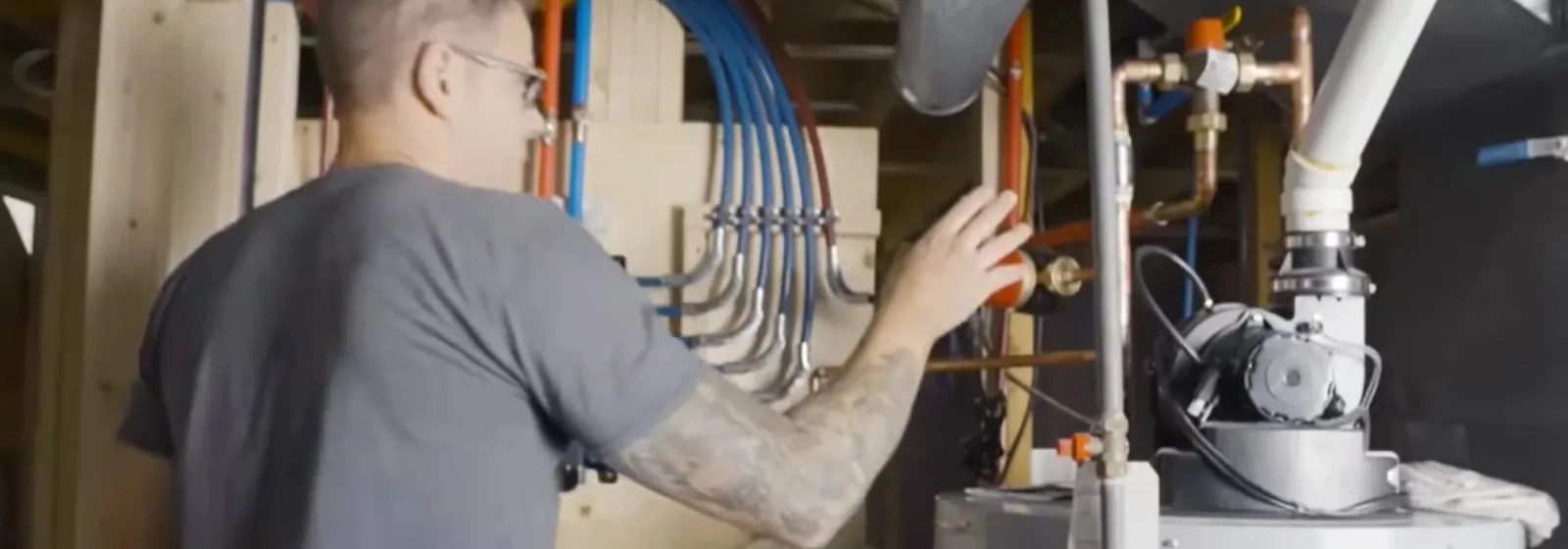
Water heater replacement in Westfield, NJ is removing a failed or worn-out tank and installing a new heater, with the water, fuel, venting, and safety connections that make it safe to run. If your tank has split and the basement is filling, you need a swap now. Close the cold water valve above the tank, cut the power or gas, and call: our dispatch line is staffed 24/7.
If the tank is merely old and you would rather choose a new one on your own schedule, that works too. The decisions are the same either way: how big, which fuel, what gets upgraded, and what the visit includes. This page walks through them in the order you will face them.
Failed tank today or a swap you planned: what changes
Tank has failed
- Water is escaping from the tank body, so the unit cannot be saved
- We match the failed unit's fuel, capacity, and vent type to get you hot water quickly
- Upgrades that need parts we cannot get the same day may be scheduled for later
- You choose from what can be installed safely in the space you have
Planned replacement
- The old tank still works, so you can compare fuels and sizes without pressure
- We can plan a larger tank, a heat pump model, or a tankless conversion, see the tankless option
- Venting, gas line, and electrical changes can be scheduled around permits
- The swap happens on a day you pick, usually without a cold-shower gap
If the tank fails tonight: what to do right now, before we arrive
A few minutes of prep can save both floor damage and time on site.
Stop the water
Close the cold inlet valve above the tank. If it is stuck, shut the main where water enters the house and open a faucet to drain the lines.
Kill the fuel
Switch off the breaker for an electric heater. For gas, turn the control dial to OFF only if you smell no gas. If you do smell gas, leave and call PSE&G.
Clear a path
Move boxes, laundry, and anything stored within a few feet of the tank. We carry out the old tank and bring in the new one, and both are heavy.
Photograph the label and the space
A picture of the rating plate, the flue, and the nearby pipes tells us what we will be replacing and what to bring.
Is the old tank beyond repair?
Water seeping from the tank body means replacement, not a repair.
Sizing the new heater to the people and the fixtures
Tank size is only half of sizing. The number that matters most is the first hour rating on the yellow label, which says how much hot water the heater can deliver in a busy hour from a full tank. A 40 gallon tank with a strong burner can outperform a 50 gallon tank with a weak one.
Add up when your household uses hot water, not how many people live there. Two showers, a dishwasher, and a laundry load in the same morning is the peak. If you have a soaking tub or a large shower fixture, that peak is higher, and a size up is worth discussing.
Oversizing wastes fuel on standby heat loss, since a larger tank keeps more water hot around the clock. Undersizing means cold water at the worst time. We ask a few questions about your mornings, look at the existing tank, and recommend a size that fits the space and the household.
Gas, electric, or heat pump: how the fuel choices compare
The best answer depends on what the house already has and what it can be made to support.
| Option | Where it fits | Trade-off to weigh |
|---|---|---|
| Gas tank, atmospheric vent | Basement with a working chimney flue and gas line | Lower first cost, but depends on a clean, properly sized flue |
| Gas tank, power vent | Spaces with no usable chimney | Needs an outlet for the blower and a vent run through the wall |
| Electric tank | Homes with no gas, or a space with no way to vent | Simple install, slower recovery, uses a dedicated 240 volt circuit |
| Heat pump (hybrid) tank | Roomy basements with air space and a drain nearby | Uses less electricity, but is taller, noisier, and cools the room |
| Tankless gas unit | Houses with room on the wall and adequate gas supply | Endless hot water but needs venting and gas capacity review |
Incentives change often. Check current programs yourself before buying, since we do not quote any.
The heat pump option, in plain terms
A heat pump water heater moves heat from the surrounding air into the tank instead of making it with a flame or a bare element. Because it moves heat rather than creating it, it can use far less electricity than a standard electric tank. It also chills and dries the room it sits in, which is useful in a damp basement and annoying in a small closet.
The unit needs air around it, a condensate drain, and usually a 240 volt circuit. Most models fall back on built-in elements when demand is heavy, so a family with a big morning draw still gets hot water. If your basement has the space and an existing drain, this is a serious option, and if not, a standard tank may fit the house better.
What a replacement visit actually includes
Here is the sequence from start to finish. If you want to walk through it for your own tank, call the dispatch line before the day is booked.
- 1
Confirm the failure
We trace the water to the tank so we do not replace a good heater because of a leaking fitting. If it is a fitting, see repair instead.
- 2
Shut off and drain
Water, fuel, and power are isolated. The tank is drained with a hose to a floor drain or outside.
- 3
Disconnect and remove
Supply lines, vent, gas or electrical connections come off, and the old tank goes up the stairs and out.
- 4
Set, connect, and vent
The new tank goes on a drain pan, with new flexible connectors or copper, a relief valve with a discharge pipe, and a vent run that meets the manufacturer's clearances.
- 5
Test and start
Gas connections are leak tested, the tank is filled with the air purged, and the burner or elements are checked through a full heat cycle.
- 6
Walk through the controls
We set the temperature, show you where the shutoffs are, and leave you with the label and model for your records.
Checks that separate a proper swap from a quick one
These are the points we look at on every replacement, and you can ask any plumber about them.
- Expansion tank sizing and air pressure, when a backflow or pressure reducing valve closes the system
- Relief valve discharge piped to a safe spot, not capped or sent into a crawlspace
- Venting slope, length, and clearances to combustibles, and a flue that is not rusted through
- Combustion air for gas units in tight rooms, so the burner can breathe
- Gas piping size and shutoff within reach of the appliance
- Drain pan under the tank, piped to a drain where one is available
- Water pressure at a hose bib, since high pressure shortens the life of any tank
- Anode rod and dielectric unions at the tank connections where dissimilar metals meet
What happens to the old tank
Draining a heater leaves a heavy shell full of sediment, and it has to go somewhere. The old tank leaves with us, and the steel is generally taken for scrap metal recycling. We do not leave it at the curb or in your garage unless you ask for that.
If you want to know why it failed, ask us to cut the anode rod out or open the drain on the way out. A rod eaten down to the core and a bottom thick with scale are signs of a tank that was run too long, and a hint that the next one needs an earlier rod check.
Permits, code, and who decides in a Westfield home
New Jersey's plumbing subcode (N.J.A.C. 5:23-3.15) adopts the 2021 National Standard Plumbing Code Illustrated, and the relief valve, discharge pipe, and expansion provisions apply to a swap. Permit rules vary by job, so ask the Westfield construction office before work starts, and we will work with whatever they tell you.
About 81% of Westfield homes are owner-occupied, which means the decision, the paperwork, and the warranty sit with you and not a landlord. Keep the invoice, the tank label, and any permit record together. A future buyer or insurer may ask to see them.
Source type: N.J.A.C. 5:23-3.15 and Census QuickFacts owner-occupancy data
What shapes the price of a new water heater
A gas tank, an electric tank, and a heat pump unit are not the same job, so the final price depends on the choices below. We quote it before work begins. Describe your tank to us and the factors below become a real figure for your house.
- The heater itselfCapacity, efficiency rating, and fuel type all move the equipment cost. Heat pump and tankless models cost more up front than a standard tank.
- Venting and gas workReusing a sound flue is straightforward. Re-lining a flue, adding a power vent, or upsizing a gas line adds labor and parts.
- Code items at the tankA missing expansion tank, a sagging discharge pipe, or no drain pan are corrected as part of a proper install.
- Access and haul-outNarrow basement stairs, a tight closet, or an attic location lengthen the job.
- TimingA same-day failed-tank swap, especially at night, is scheduled differently from a booked daytime install.
A burst tank that floods a room is the kind of sudden event many homeowners policies address, while a tank that rusted through over years often is not. Read your policy, photograph the tank and the damage, and call us to plan the swap while you talk to your insurer.
Water heater replacement questions from Westfield homeowners
Yes, a failed tank at 2 a.m. or on a holiday gets the same response path as a weekday call, with same-day appointments when available. Tell us the fuel, the tank size on the label, and whether the water is off, so the right unit is on the truck.
Water coming from the tank body, usually at the base or along a seam, means replacement. A leak at a fitting, valve, or drain can often be repaired. Rusty water from hot taps only, rumbling, and repeated repairs on an old tank also point to replacement.
Our water heater repair page has a table that sorts symptoms by cause.
Usually yes, but the house has to support it. Electric and heat pump models need a 240 volt circuit with spare capacity in the panel. Heat pump units also need air space and a drain. We check the panel and the room before recommending a change.
A straight swap of the same type is normally done during one visit, since most of the time goes to draining, hauling, connecting, and heating the first tank of water. Changes that need new venting or electrical work can take longer. We tell you the plan when we see the space.
Permit rules vary by job, so ask the Westfield construction office before work starts. We can describe exactly what is being replaced, which is what they will want to know.
Yes, we serve Westfield and nearby towns. If you are in the next town over, our Scotch Plains plumbing page covers that service area.
That is a different job, because new venting, gas piping, and permits come into play. See water heater installation for how that is handled.