

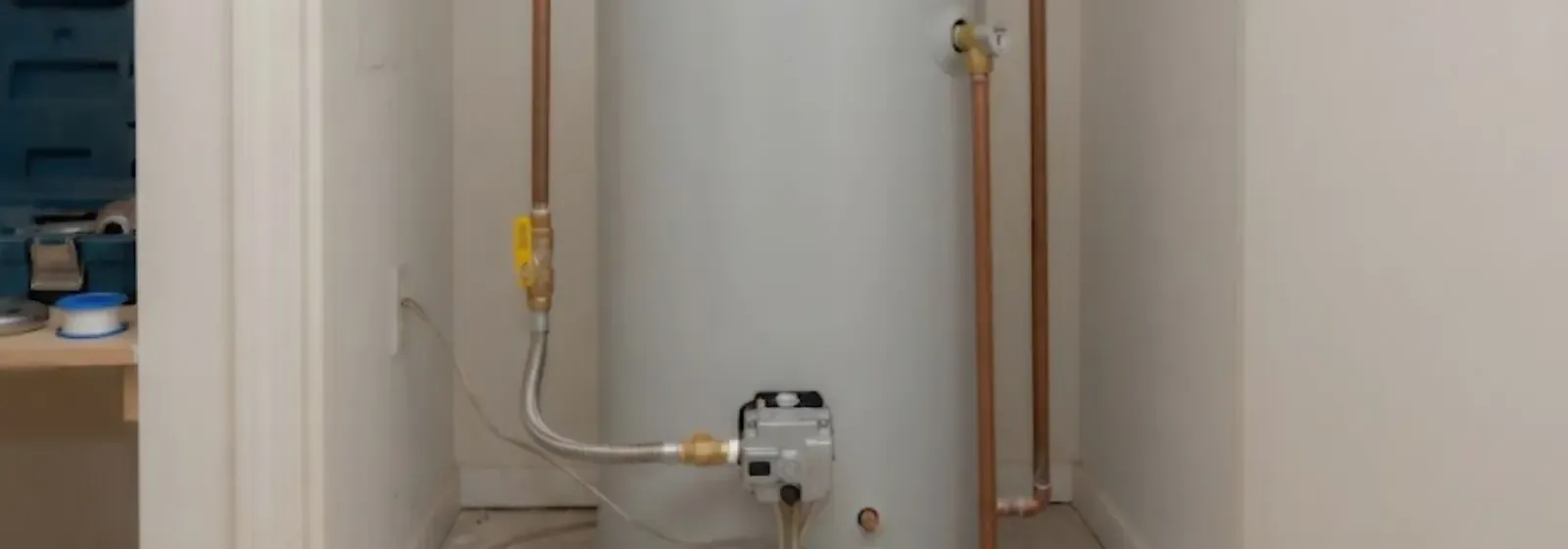
Water heater installation in Westfield, NJ is putting a new heater where none stood before, or moving one to a new spot, or changing its fuel. That is different from swapping a failed tank in place, because the vent, gas piping, drain, and power may all have to be created or changed. The work should be planned on paper before anyone touches a pipe.
Most of what goes wrong on a new install is invisible once the tank is set: a vent that is the wrong size, a gas line that cannot carry the load, a discharge pipe that ends nowhere. This page covers the questions we settle before we set a tank.
Questions we answer before we quote an install
If you can answer these, the planning goes quickly. If you cannot, we find out on a site look.
- What fuel is available at the proposed spot: gas, electric, or neither?
- Where will the exhaust go, up an existing flue, through a wall, or through the roof?
- Is there a floor drain, sump, or exterior wall within reach for the discharge pipe and drain pan?
- How big is the gas pipe feeding that area, and what else does it serve?
- Is there a spare 240 volt circuit and room in the electrical panel?
- Does the room have enough air for a gas burner, or will it need outside combustion air?
- Can the tank get down the stairs and through doorways?
- Is the house in an area where exterior changes, like a wall vent, may need a second look?
Install situations and what changes in each
The sticker on a tank does not tell you what the job will take. The location does.
| Situation | What is new | What we check first |
|---|---|---|
| Moving the heater to another room | Water lines, drain, vent or power | Pipe route, vent length, floor drain |
| Gas to electric conversion | A 240 volt circuit, no vent | Panel capacity, wire route |
| Electric to gas conversion | Gas line, vent, combustion air | Gas pipe size, flue or wall route |
| First heater in an addition or garage | Everything | Freeze risk, drain access, clearances |
| Attic or closet install | Pan, drain, access | Floor load, leak path, service space |
Each case is checked on site because the house decides the route.
Planning a conversion?
Tell us the fuel you have and the fuel you want.
Putting a heater somewhere new
Moving a tank is mostly an exercise in pipe runs. Hot and cold lines have to reach the new spot, and the farther the heater sits from the kitchen and baths, the longer you wait for hot water at the tap. A recirculation line is one fix, and it is usually considered at this stage and not after.
The new spot also has to survive a leak. A heater over a finished ceiling, an attic, or a closet with no drain is a flood waiting to happen, so the pan, the pan drain line, and a leak alarm are not extras there. If you are weighing a location against a basement corner, our water heater replacement page explains how sizing and fuel choices fit together.
Venting choices: what each one needs from the house
Existing chimney flue
- Cheapest path if the flue is sound and the right diameter
- Needs a liner when the flue is too large for a small modern burner
- Cold exhaust can condense and drip in oversized masonry chimneys
- Works only when the heater sits near the chimney
Power vent or direct vent through a wall
- Frees the heater from the chimney location
- Needs a power outlet for the blower on a power vent
- Needs a vent termination at a safe distance from windows and the meter
- A sealed direct vent unit draws combustion air from outdoors, so the room matters less
Combustion air and the closet problem
A gas burner uses oxygen from the room. In a large, leaky basement that is rarely a concern. In a tight closet or a sealed utility room, the burner can starve, burn with a yellow flame, and make carbon monoxide.
The fix is either to open the room to outside air through sized openings or ducts, or to choose a sealed combustion model that brings its own air in through a pipe. We will not set a gas tank in a tight closet and call it done. A working carbon monoxide alarm nearby is cheap and worth having whatever we install.
Vent and air requirements come from the maker's installation instructions and from the plumbing code. New Jersey's plumbing subcode adopts the 2021 National Standard Plumbing Code. Your local construction office decides what permit applies.
Gas line sizing: does the pipe have the capacity?
Every gas appliance on a line draws from the same supply. The pipe diameter and the length from the meter determine how much it can carry, and the sizing is done by a table in the plumbing code. A heater tapped into a line that already feeds a furnace, a stove, and a dryer can starve all of them when everything runs at once.
On a new install we count the appliances, measure the run, and decide whether the existing pipe is enough or a larger branch is needed. If you are not sure the gas line has room for a bigger-burner appliance, call the dispatch line and describe what already runs on it. Smell gas at any point and the rule is the same as everywhere: leave, go at least 350 feet away, and call PSE&G or 911 first.
Drain pan, discharge line, and the water you will never see
A pan under the tank catches a slow leak or a failed fitting, and a pan drain pipe carries that water to a safe place. The relief valve has its own discharge line, which should run downhill to a visible spot, not into a wall. Both lines are checked on every install because they only matter when something has gone wrong.
Where no floor drain exists, a condensate-style pump or a route to the outside may be needed, which is part of why a new location can cost more than the same tank in the old spot. Ask where the water would go if the tank failed in the new place. That question alone catches most poor locations.
Code and permit sequence for a new installation
The order matters. Permits and inspections come in a sequence, and starting out of order costs time.
- 1
Walk the site
We look at the spot, the route, the panel, and the gas meter, and list what has to be created.
- 2
Agree on the plan
You get the options, the fuel choice, and a clear price before work starts.
- 3
Check the permit question
Permit rules vary by job, so ask the Westfield construction office before work starts. We can supply the scope of work they need.
- 4
Rough in
Water lines, gas branch, venting, discharge piping, and electrical go in before the tank is set, and are tested while exposed.
- 5
Set and connect
The tank goes on its pan with the relief valve, expansion tank where required, and shutoffs at reach.
- 6
Final checks
Gas leak test, vent draw test, water temperature, and any inspection the town requires.
Older basements and historic-district houses in Westfield
About 37% of homes in ZIP 07090 were built in 1939 or earlier. Older basements tend to have low ceilings, tight stairs, and an original chimney, so a taller tank may not fit and the flue may not suit a modern burner. We measure the stairs and the headroom before we order the tank.
The town's preservation plan identifies districts such as Dudley Park, Prospect Street, and Boulevard, and Kimball Avenue is the only locally designated historic district. If your house is in one of them and you are planning a new exterior wall vent, ask the Westfield construction office whether anything applies before the work is scheduled. The question costs a phone call and avoids a redo.
Source type: Census ACS housing data and the town's Historic Preservation Master Plan Element
What goes into the price of a new water heater installation
A new installation is priced from the site, not the tank. We cannot give a number over the phone, but we can explain what moves it and put a clear figure in writing before work starts.
- Distance from existing servicesEvery foot of new water, gas, vent, or wire adds material and time.
- Venting methodReusing a flue, lining it, adding a power vent, or running a wall vent are very different jobs.
- Fuel conversionA gas to electric change may need panel work. Electric to gas needs a gas branch and a vent.
- Drain and pan arrangementNo floor drain means a longer discharge route or a pump.
- Permit and inspection stepsTime spent coordinating with the town and being on site for inspection is part of the job.
Insurance rarely pays for a planned upgrade or a new location, so treat an install as your own project cost. A policy may respond to a sudden leak later, but not to wear, so read it. If you want to talk through a planned install, call (908) 357-1542 and tell us where the heater is going.
Water heater installation questions
A replacement puts a new tank where the old one stood, using the same water, gas, and vent connections. An installation creates or changes those connections for a new spot, a new fuel, or a first heater.
If your tank has just failed, see our repair page first to confirm that it needs replacing.
Often yes. We check pipe routes, the vent path, the drain, and power or gas in the new spot. The farther the move, the more the job involves. A move can also change how long you wait for hot water at the faucets.
Permit rules vary by job, so ask the Westfield construction office before work starts. Tell them what is being installed, the fuel, and whether a vent or gas branch is being added.
Not automatically. The room needs combustion air, a vent that works, and a gas supply with spare capacity. Sealed combustion models help in tight rooms.
Yes, we serve Westfield and nearby towns, including Scotch Plains. We look at each house on site before we price it.
Sometimes. It saves floor space and gives continuous hot water, but it needs a larger gas supply and a proper vent. Our tankless water heater page has a table to decide.
Yes. Planned installs are booked by appointment, and urgent failures go through the same phone number at any hour.