

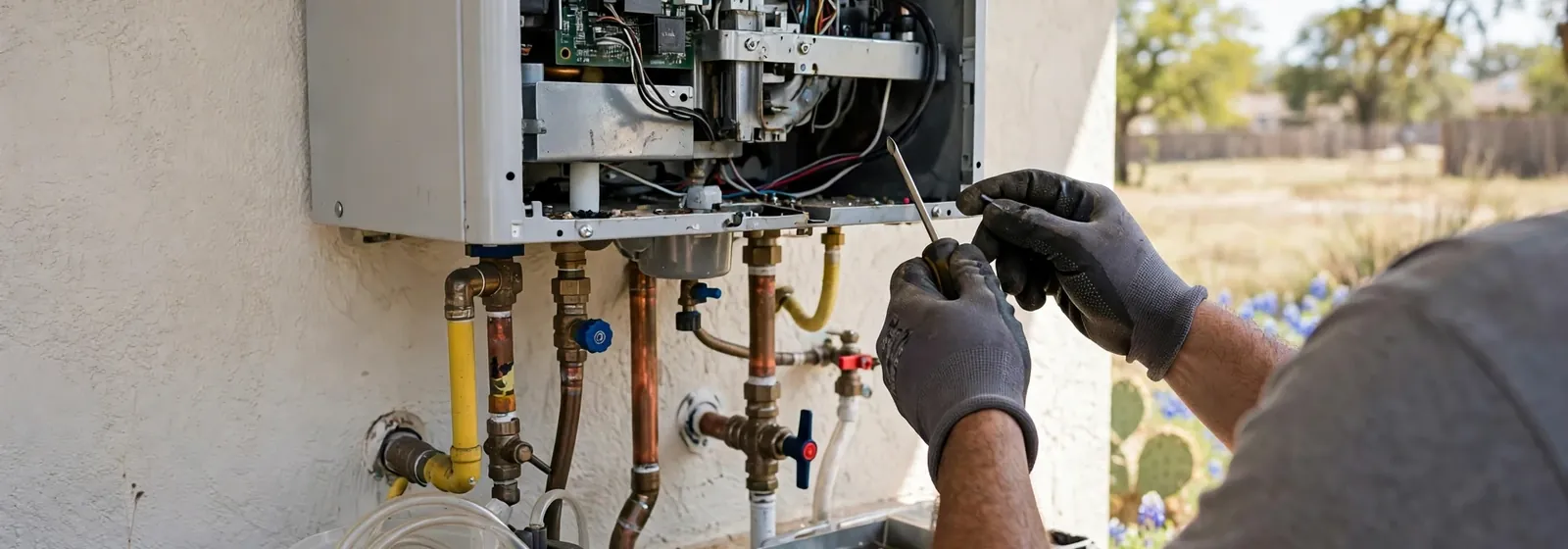
A tankless water heater in Westfield, NJ is an on-demand unit that heats water only while a tap is open, using a gas burner or electric elements and a heat exchanger instead of a stored tank. We install them, repair them when they throw error codes or run cold, and flush the scale out of them on a schedule. They are not right for every house, and we will say so.
The common questions have little to do with the brand. They are about flow, gas supply, venting, and whether the local water will scale up the heat exchanger. Those are the things the sections below take on.
Is a tankless heater right for this house?
Use this as a quick screen. If more than two rows land in the right-hand column, talk to us before you buy.
| Question | Good fit | Think twice |
|---|---|---|
| Gas supply and pipe size | Gas line has spare capacity and a short run | Original small pipe shared with furnace and stove |
| Venting route | Short wall or roof path to outside | Long vertical run or no path at all |
| Hot water use pattern | Steady use, a few fixtures at once | Several showers and laundry all at the same moment |
| Water quality | Soft or treated water, easy to flush yearly | Hard scale-prone water and no service valves |
| Space | Wall space where a tank no longer fits | Closet that cannot take a vent and gas line |
| Electric supply | Outlet within reach for the fan and controls | No power near the chosen wall |
Fit is decided on the house, not the product.
Flow rate and temperature rise, in plain numbers
Two numbers decide whether a tankless unit keeps up. The first is flow, measured in gallons per minute: how much water the household wants at once. The second is temperature rise, the number of degrees the unit must add to the incoming water to reach the setting you want.
Incoming water is colder in winter, which raises the rise you need and lowers the flow the unit can deliver. A unit that handles two showers in July may struggle with them in January. We size to the cold-weather case, since that is when you notice a shortfall. Count the fixtures that run together, and tell us if you have a large soaking tub or body sprays.
Error code or cold-water bursts?
Note the code on the display before you reset it.
Gas capacity is the question most buyers skip
A tank burner is small and runs for a long time. A tankless burner is large and runs only when you ask for hot water, so it draws far more gas at the moment of use. The gas piping and the meter that served a tank may not carry that load alongside a furnace, a stove, and a dryer.
Older houses are where this comes up most. About 37% of homes in ZIP 07090 were built in 1939 or earlier, and the median build year is about 1953, so the original gas piping may be small and may have been extended over the years.
We count appliances and measure the run before recommending a unit, and we will tell you if the line needs upgrading first. For the broader planning side, see how a new heater location gets planned.
Venting: what a tankless unit needs to breathe
Condensing units
- Run cooler exhaust, so the vent can be plastic pipe
- Need a drain for acidic condensate, often to a floor drain
- Vent runs are easier to route through walls
- Need the condensate path checked every year
Non-condensing units
- Run hot exhaust, so they need stainless vent pipe
- Do not produce condensate, so no drain is needed
- Vent runs are more restricted by clearance rules
- Cost less up front, use more fuel
Repair: what the usual tankless faults look like
When a tankless unit stops working, the display usually names the problem. Write down the code before you reset anything.
Cold water in the middle of a hot shower
Short bursts of cold are often caused by a clogged inlet screen, a low flow that does not trip the burner, or a mixing valve elsewhere in the house.
Error code and no hot water
Ignition failures, flame loss, and exhaust blockages each have their own code. The cause is a failed igniter, a dirty sensor, or a restricted vent.
Water too hot or swinging
A fouled heat exchanger or a dirty thermistor misreads temperature. Descaling often settles it.
Rumbling or kettle sounds
Scale on the heat exchanger traps tiny steam pockets. Left alone, the exchanger overheats and fails.
Condensate leak at the base
A blocked condensate trap or a cracked drain line drips onto the floor. It is a repair and not a reason to scrap the unit.
Tankless flush and descale: the service that keeps the warranty and the unit alive
Heating water drives dissolved minerals out of it, and they stick to the hottest surface: the inside of the heat exchanger. A tankless unit has narrow passages that scale restricts. The result is less flow, noisy operation, error codes, and eventually a cracked exchanger. A flush removes the scale before that point.
The standard method is to close the isolation valves and connect hoses to the service ports. A small pump circulates a descaling solution, usually a mild acid like white vinegar or a manufacturer-approved cleaner, through the heat exchanger for roughly 45 minutes to an hour. Then the unit is flushed with clean water, the inlet screen is cleaned, and the gas and vent connections are checked at the same visit.
A unit with no service valves cannot be flushed properly, so we add a valve kit when one is missing.
How often to flush depends on your water, and we cannot say a number without a reading: test your tap with a hardness kit, and ask New Jersey American Water for its latest water quality report. Hard water means yearly or more often. Soft water can stretch it. Some warranties ask for proof of regular maintenance, so check yours and keep the records. The annual visit also covers the exhaust and condensate checks that a descale alone would miss.
How a tankless installation runs
A conversion from a tank takes planning, since nothing in the old setup lines up.
- 1
Load and gas check
We add up fixtures and appliances, measure the gas pipe, and decide whether the supply is enough.
- 2
Pick a wall and a vent path
The unit mounts on a wall near an outside exit. We route the vent before anything else.
- 3
Rough in
Water lines, isolation valves, a condensate drain if needed, and a larger gas branch go in.
- 4
Mount and connect
The unit goes on the wall, vent sealed, water and gas connected, with shutoff valves and a service valve kit on both lines.
- 5
Commission
We test gas pressure, check the flame, set the temperature, and run taps to confirm flow. Permit rules vary by job, so ask the Westfield construction office before work starts.
Scale depends on the water at your tap
We do not quote a hardness figure for Westfield, because we have not seen a verified one for your address. The sensible step is to test your tap with a hardness kit and ask New Jersey American Water for its latest water quality report. The result sets how often you flush.
Housing age comes into it too. A 1950s house may have the original gas piping and an old chimney that the tankless unit will not use. When a tank is retired for a tankless unit, the old flue is usually capped or lined, which is a small job but one that has to be done. Our replacement page covers the like-for-like option for houses where tankless is not a fit.
Source type: utility water quality report and Census ACS housing data
What affects the cost of a tankless job
We price the job after we see the gas line, the wall, and the vent path. A flush is a smaller visit and an install is a larger one, and the line between them depends on the house. Call the dispatch line and we will walk through the details for your unit.
- Unit type and capacityCondensing, non-condensing, gas, and electric units differ in price, and so does the flow they deliver.
- Gas pipe upgradeA larger branch from the meter or a new run is often the biggest hidden item.
- Vent pathShort through-wall runs are simple. Long runs, roof penetrations, and flue capping add labor.
- Isolation valves and condensate drainService valves make flushing possible. A drain for condensate may need a pump.
- Scale condition for service callsA unit that was never flushed takes longer to descale than one on a schedule.
A failed heat exchanger from scale is wear, and wear is what homeowners policies commonly exclude, while a sudden burst is a different matter. Read the policy, and call (908) 357-1542 if you want the unit looked at before it fails.
Tankless questions homeowners ask us
It depends on the water, and we cannot give a number without a reading. Test your tap with a hardness kit and ask New Jersey American Water for its latest water quality report. Yearly is the common starting point, and harder water means shorter gaps.
If the unit has isolation valves, a pump, hoses, and a descaling solution, a careful homeowner can do it. The risks are mixing up the hoses, leaving a valve closed, and skipping the burner and vent checks. We do the full service on request.
The usual causes are low flow that does not keep the burner lit, a clogged inlet screen, and a fouled heat exchanger. Rapid on-off use can also let cold water slip between short draws.
It can save standby heat loss, since there is no tank keeping water hot. But installation can cost more, and scale or a skipped flush can erase the benefit. The saving depends on use and upkeep.
Usually not as is. Tankless exhaust is different and the chimney needs to be lined, capped, or bypassed. We check the flue on the visit.
Yes. We serve Westfield and nearby towns, and the Scotch Plains page explains that service area. Ask your own water utility for its report, since water differs by town.
Yes. If you smell gas, leave first and call PSE&G or 911. For a unit that is dead or leaking, call any hour and we book same-day appointments when available.