

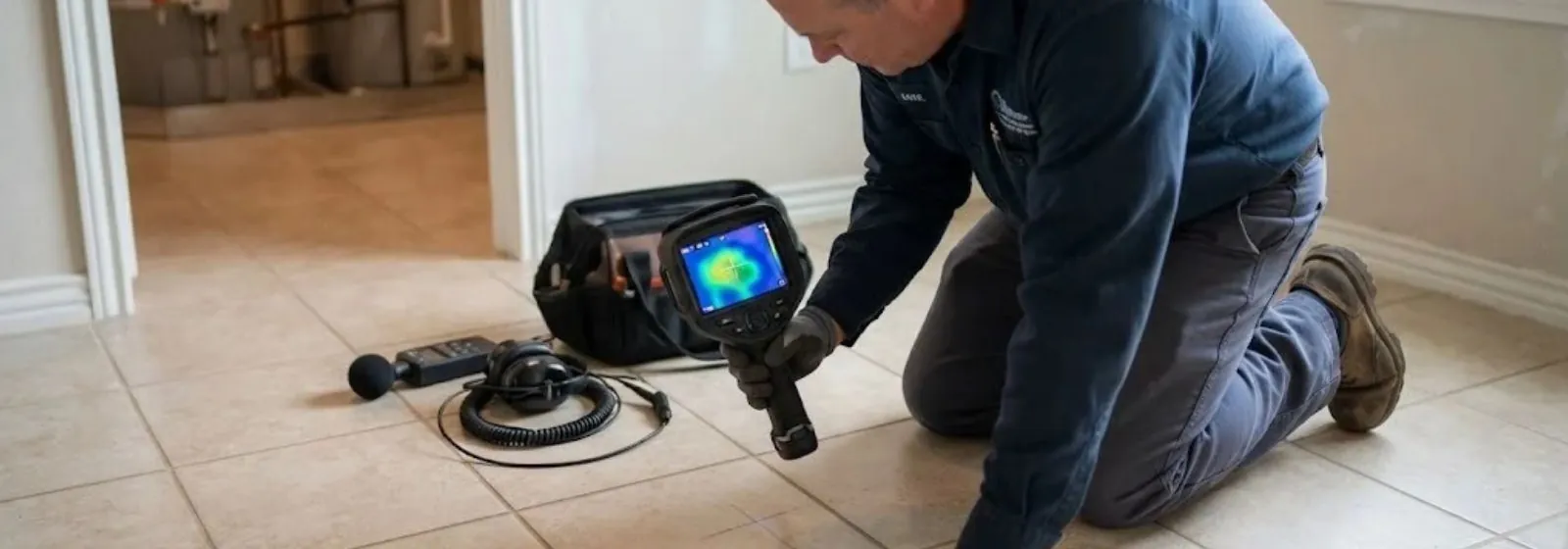
A hidden water leak turns into an emergency when the meter keeps moving with every fixture off, a ceiling starts to bulge, or water pools where it should not. Leak detection in Westfield, NJ means finding the exact spot where a pipe is losing water before anyone cuts into plaster, flooring, or a lawn. Our 24/7 dispatch line answers at night and on weekends, and you can limit the damage while you wait by closing the main shutoff.
Most leaks announce themselves late. A pinhole in a copper line behind a plaster wall can weep for months, and the first sign is often a bill that looks wrong or a paint blister the size of a coin. Below are the symptoms we hear about most, how each one is traced, and where the methods run out.
Water Is Moving Right Now: Do This Before We Arrive
Each move costs nothing and needs no tool.
Close the main shutoff
Find the valve where the water line enters the basement, usually near the meter. A ball valve closes with a quarter turn, and an older gate valve closes clockwise until it stops. Then open the lowest tap in the house to drain the pressure.
Keep power away from water
If water is dripping near a light fixture, outlet, or electrical panel, switch off that circuit only if you can reach the breaker while standing on dry floor. If you cannot, stay out of the room and tell the dispatcher.
Photograph before you clean
Take pictures of the stain, the wet floor, and the meter face with the reading visible. A dated photo shows how fast the damage is growing and gives an insurance adjuster something concrete.
Record a quiet meter reading
With every tap, the ice maker, and the washer off, write down the meter reading. Check it again after 15 minutes. Any movement means water is leaving the system, and the number helps us decide where to start.
What Your Symptom Usually Points To
The symptom is the starting point, not the answer. This is how we read the six we hear about most.
| Symptom | Common cause | First check |
|---|---|---|
| Meter moves with every tap off | Loss after the meter: a toilet, a supply pipe, or the service line | Dye test the toilets, then close the main and watch the meter again |
| Bill jumped, no change in habits | A silent toilet leak, a stuck irrigation zone, or a weeping buried pipe | Compare estimated and actual reads, then run a quiet meter test |
| Brown ceiling stain that keeps growing | Supply or drain above, a roof or window leak, or condensation | Moisture meter from the wet edge toward the dry edge |
| Damp drywall at the baseboard | A fixture supply, a branch in the wall, or a tub overflow | Moisture mapping, then pressure test of that branch |
| Musty basement with no puddle | A weeping joint or a slow drain leak behind finished walls | Humidity readings and listening at the pipes |
| Soft or sunken patch in the lawn | Irrigation, a yard line, or the service line | Shut the zone valves, run the meter test, listen along the route |
A symptom can have more than one cause, and the first check often rules out the cheapest one.
Meter still turning?
Close the main shutoff, then call the dispatch line and read us the meter.
Water Meter Still Turning or the Bill Jumped
Start at the meter, because it answers the biggest question: is the water leaving through a fixture or through a pipe. Shut off every tap, the ice maker, and the washing machine, then look at the leak indicator on the register. Most residential meters carry a small triangle or low-flow dial that moves at a trickle, so if it turns, water is going somewhere.
A moving indicator does not yet mean a buried leak. Toilets are the usual culprit, because a worn flapper lets water slip into the bowl without a sound. Put a few drops of food coloring in each tank and wait 15 minutes without flushing. Color in the bowl means that flapper is the leak.
If the toilets pass and the indicator still moves, close the house main and watch again. A meter that stops means the loss is inside the house. A meter that keeps moving points to the pipe between the meter and your shutoff, or to the service line, which is covered further down.
A high bill with a still meter is a different problem. Check whether the bill used an estimated read, whether a sprinkler zone stuck open, and whether anyone filled a pool or ran a hose. If the numbers still do not add up, call our dispatch line and we will walk through the meter reading with you before sending anyone.
Ceiling and Wall Leaks: The Stain Is Not the Source
Water travels. It follows a joist, a pipe, or the back of a stud for several feet before it finds a seam and shows up as a stain. So the wet spot on your ceiling is where the water appeared, and the leak itself is usually higher and to one side.
We work from the edges of the stain toward the dry area with a moisture meter, then map the wet boundary on the surface. A thermal camera adds a second view, because wet material evaporates and runs cooler than dry material beside it. That helps most on hot supply lines, where the warm path shows up clearly.
A camera is not an x-ray, though. In summer a cold supply line sweating in humid air looks like a leak on the image and is not one. The cure there is insulation on the pipe.
Not every ceiling stain is plumbing. Roof flashing, a window, an air handler drain, and a bathroom fan vented into an attic all leave the same brown ring. If the stain grows only after rain, we will say so when our readings clear the pipes.
If a ceiling is bulging, you can relieve it by poking a small hole at the lowest point over a bucket. Do this only when no light fixture sits in the wet area.
Leaks Under the House: Basement and Crawlspace
In a basement house, the pipes you can see are the easy part. Look along the ceiling for drips, green crust on copper joints, rust blooms on galvanized fittings, and wet insulation. Cast iron drain stacks can weep at the hub joints, and the stain below them tends to be dark and gritty.
A heating system with an automatic fill valve can hide a leak in the boiler loop, because it keeps topping the system up. If the fill valve clicks often or the pressure gauge keeps returning to the same number, the loop is losing water somewhere. We trace that with a pressure test on the heating side separately from the domestic water.
Water that shows up on the basement floor only after heavy rain is groundwater, not a pipe. That is a drainage problem, and the better fixes are covered under basement waterproofing and sump pump work. A crawlspace under an addition works the same way. We check the pipes overhead, then the soil and vapor barrier for damp patches that line up with a supply or drain run.
Underground, Yard, and Meter-Box Leaks
Buried leaks leave clues at the surface. Look for a patch of lawn that stays green or soft in dry weather, a sunken spot over the line route, a meter box full of water, or a hissing sound at the main with everything off. Pressure that has slowly dropped through the whole house is another sign.
Before any digging starts, call 811, as New Jersey requires. We locate the loss first so the excavation is one small hole instead of a trench. Acoustic listening comes first: a ground microphone and contact sensors on valves pick up the hiss of pressurized water leaving a pipe, and the sound is loudest directly over the leak.
Honest limits apply. Plastic pipe carries sound poorly, traffic and furnace noise can drown out a small leak, and deep lines are harder to hear. When listening is not enough, a tracer gas test fills the isolated line with a harmless gas mix and a sensor sniffs the surface for it. It is slower, but it can confirm a spot that sound could only suggest.
Water Service Line Leaks Between the Street and the House
The service line runs from the water main under the street to your meter and shutoff. It is buried, it is out of sight, and it is the pipe nobody thinks about until the yard turns wet. Two things you can find yourself are the house shutoff and the meter, and together they run the best test there is.
Close the house shutoff, confirm every tap is off, and watch the meter indicator for several minutes. If it keeps turning, the water is leaving between the street and your shutoff. If it stops, the service line is holding and the loss is inside the building.
Who maintains which section of the line is a question for the utility, so we do not guess. Ask New Jersey American Water where its responsibility ends before anyone digs, and tell us the answer so we can plan around it. If the loss is on the utility's side, a call to the utility is the first move, and our readings give you something specific to report.
Is It the Utility's Main or Your Pipe? Lessons from East Broad Street
On December 12, 2020, a New Jersey American Water main broke near 126 East Broad Street, between Prospect and Elm Streets. About 20 commercial and 30 residential customers lost service, East Broad was closed, and the repair was expected to take about 16 hours. The lesson for a homeowner is that mains and services can fail with no warning, and the quickest sorting question is who else is affected.
If neighbors report low pressure or a wet street, call the utility. If only your house is affected, run the meter test above, because the loss is probably on your side of the connection.
Housing age matters here too. About 37 percent of homes in ZIP 07090 were built in 1939 or earlier, and the median build year is around 1953. We do not assume what any one house contains, since pipes get replaced piecemeal over the decades. Mixed materials in one house are common in older homes, and the joints between them are where a quiet leak often starts.
Source type: utility press release and Census housing data
Irrigation, Pool, and Spa Leaks
Sprinkler systems fail at valve manifolds, buried fittings, and heads cracked by a mower. To isolate one, close the irrigation supply and rerun the meter test. If the meter stops, the loss is in the sprinkler lines, and zone-by-zone testing then narrows it to a single valve or run.
A pool or spa that drops more than a day of normal evaporation can leak at the skimmer, the return fittings, the equipment pad, or the buried lines. We test the plumbing lines with pressure plugs, and any leak in the shell, liner, or equipment belongs to a pool specialist.
Slab Leaks: Uncommon Here, Still Possible
Houses with a basement run their supply lines through the ceiling joists, not under a slab, so classic slab leaks are uncommon. They are possible under a slab addition, a garage conversion, or a sunroom. Warm spots on a floor, the sound of running water in a silent house, or a hot water bill that climbs in summer are the signs we look for.
How We Trace a Hidden Leak
Each step rules out part of the system so the next one has less to search.
- 1
Read the meter and your story
We note the meter reading, when the symptom started, which fixtures run, and whether anything changed recently. Details like a new dishwasher or a sprinkler repair narrow the search quickly.
- 2
Isolate sections
We close valves in sequence: the house main, the water heater, the irrigation feed, and individual branches. The meter tells us which section still loses water.
- 3
Pressure test the suspect run
A gauge on a hose bib or a capped branch shows whether the line holds pressure. A needle that drifts down confirms a leak in that run, even when nothing is visible.
- 4
Listen and scan
Acoustic sensors pick up the sound of escaping water. A moisture meter and a thermal camera map wet material on walls, ceilings, and floors without opening them.
- 5
Confirm before opening
When two methods agree, we mark the spot. If they disagree, we try tracer gas or a third test, because the smallest possible access hole is worth the extra time.
- 6
Write up the repair options
We explain the leak location, the pipe material, what a repair opens up, and what it would take to replace the run. Detection and repair are separate decisions, and you choose the second after seeing the first.
What Leak Detection Cannot Promise
We cannot see through concrete or soil, and every method gives evidence, not a photograph of the hole. Some leaks need two methods to agree, and a few stay stubborn after both. We also cannot state a number before looking, because depth, access, and the number of methods needed change the work.
What Affects the Cost of Leak Detection
Detection is priced by how hard the leak is to reach, not from a flat list. After the first look at the system, you hear the figure before we continue.
- Where the leak isA basement ceiling pipe is quick to inspect. A line under a driveway or a floor needs more equipment and more time.
- How many methods are neededA meter test and a pressure test may settle it. Acoustic listening, thermal imaging, and tracer gas each add steps.
- Size and layoutMore floors, finished walls, and branches mean more isolation tests and more to scan.
- Finishes that need openingTile, plaster, and cabinets cost more to open and patch than unfinished framing, and the patch is a separate trade.
- The repair itselfFixing a fitting is a short job. Replacing a section of line, or a whole run, is a larger one and gets its own price.
Many homeowners policies address sudden accidental discharge but exclude wear, corrosion, or slow seepage, so read yours before assuming either way. Notes from the leak trace can support a claim, but we cannot promise an outcome. To book a trace or ask what your situation involves, call (908) 357-1542.
Leak Detection Questions We Hear Often
Yes. The dispatch line runs 24/7, and a meter that keeps spinning at 2 a.m. gets the same attention as one at noon. Tell the dispatcher what the meter and the water are doing, and close the main shutoff while you wait.
Turn off every tap and appliance, then watch the leak indicator or the smallest dial for several minutes. If it moves, water is leaving the system. A toilet flapper is the first thing to rule out.
Usually only a small access hole, and only after meter, pressure, and scan results agree on where to open. Locating the leak first is what keeps the opening small. The patch and paint afterward are done by a drywall or plaster trade.
The meter test sorts it. If the indicator moves with your house shutoff closed, the loss is on the service side, so ask the utility where its responsibility ends. If it stops when you close the shutoff, the leak is inside your plumbing.
Finding the leak is one job and repairing it is another. After the trace we explain the repair options, and you decide. Permit needs depend on the repair, so ask the Westfield construction office first.
Yes. We dispatch across Westfield and nearby towns, including Scotch Plains. If a pipe has burst rather than seeped, the page on burst pipe repair covers the faster path.
When the same run leaks repeatedly or the pipe is corroded along its length, patching stops making sense. That is a repiping conversation, and we lay out the trade-offs after the trace.