

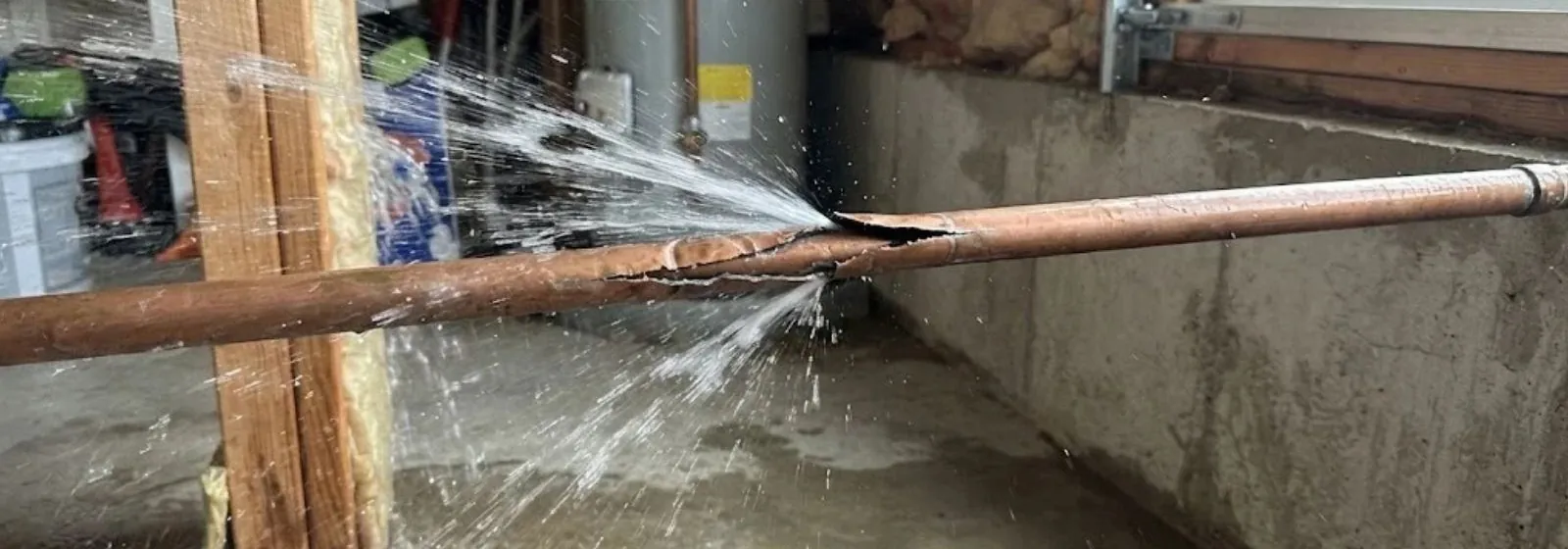
A burst pipe can put gallons per minute into a ceiling, so the first minutes matter more than anything we do later. Burst pipe repair in Westfield, NJ means stopping the water, cutting out the split section, and rebuilding the line with the right fittings for the pipe material. Our dispatch line runs 24/7, and the single best thing you can do while you wait is to close the main shutoff.
Pipes burst for three main reasons: ice, corrosion, and pressure that finds a weak spot such as a failed valve or a poor joint. Each one leaves different clues and calls for a different repair. This page covers how to tell them apart, how to thaw safely, and what each pipe material allows.
A Pipe Just Burst: Shut Off the Water First
Do these in order. The first one stops most of the damage on its own.
Close the main
Turn the main shutoff until it stops. A ball valve has a lever that turns a quarter turn, and a round gate valve handle turns clockwise. Open a tap on the lowest floor afterward to drain what is left in the pipes.
Kill power in the wet area
If water is falling through a ceiling light, near an outlet, or toward the panel, turn off the breaker only if you can reach it from dry floor. Otherwise stay out and tell the dispatcher.
Open the high taps
Run an upstairs cold tap and a hot tap to drain the lines faster. Do not run hot water if you think the pipe is frozen and the heater is still firing.
Protect what you can lift
Move rugs, electronics, and boxes out of the drip zone. Put a bucket under drips, photograph the damage, and keep wet materials for an adjuster to see.
Utility Main Break or Your Own Burst Pipe
A water main break and a burst pipe in your house feel alike at first, since both can mean no pressure and a wet floor. They differ in where the water appears. On December 12, 2020, a New Jersey American Water main broke near 126 East Broad Street, closing the road and affecting about 20 commercial and 30 residential customers, with the repair expected to take about 16 hours.
If water is coming up through the street or lawn, or several neighbors lost pressure at once, call the utility. If the water is inside your walls, ceilings, or basement, close your own main and call us. A quick check helps: with the main closed, the house should stop leaking. If the water keeps coming in from outside the foundation, the source is not your supply piping.
Source type: utility press release
Pipe just burst?
Turn the main shutoff clockwise or a quarter turn, then call the dispatch line.
Signs a Pipe Has Split Behind the Wall
Not every burst is dramatic. Some start as a hiss and a bulge, and the damage builds for hours.
A sudden drop in pressure
Faucets sputter or run weak on one floor while another is normal. That points to a break on the branch feeding the weak fixtures.
The sound of running water
A hiss or trickle inside a wall with every fixture off means pressurized water is escaping. Close the main and listen again.
A swollen or sagging ceiling
Drywall holds water until it becomes heavy and bulges. Bulges mean a lot of water has pooled above.
Water at a baseboard or outlet
Damp trim or a wet wall near an outlet suggests a split inside the cavity. Keep power off that area.
A meter that will not rest
With every tap off, a moving meter means water is leaving somewhere. If it is slow, our leak detection page explains how we trace it.
Frozen Pipes: Thaw Safely and Never With Flame
Water expands when it freezes, and the pipe usually splits where the ice plug sits, not where the water is trapped. The split often stays closed while the ice holds, then opens as it melts. So a frozen pipe that looks fine can start spraying the moment it thaws.
If a tap gives only a trickle in cold weather, shut the main first, then open the tap so melting water has somewhere to go. Warm the pipe from the faucet end back toward the cold section using a hair dryer, a heating pad, or towels soaked in warm water. Never use a torch, a propane heater, or any open flame. Flame can ignite framing or insulation, and it can overheat soldered joints until they fail.
Risk is highest in pipes inside exterior walls, unheated garages, crawlspaces, and rooms above garages, and at hose bibs with a hose left attached. Pipes in those spots deserve insulation or a cabinet door left open on cold nights. If the pipe is already split, or if you cannot reach it, call our dispatch line and tell us where the pipe runs.
Repair Options by Pipe Material
The right fix depends on what the pipe is made of and how much of it is worn. This is the short version.
| Material | How it usually fails | Repair options | Limits |
|---|---|---|---|
| Copper | Split along the side after a freeze, or pinholes from corrosion | Cut out the section and join new copper with soldered or press fittings | Pinholes in several spots mean the run is wearing out |
| PEX | Cracked fitting or a pipe damaged by a nail or screw | Cut out the damage and join with crimp, clamp, or expansion fittings | Tolerates more freezing than rigid pipe, but fittings can still crack |
| Galvanized steel | Corrosion from the inside, leaking at threaded joints | Replace a short section with unions or couplings, or move to new pipe | Neighboring joints often fail soon after, so a long repair often turns into a replacement |
| Supply valves | Seized handle, leaking stem, or a cracked body | Replace the valve and the short stub it connects to | A main shutoff that will not close needs attention right away |
Temporary clamps and push-fit couplings stop water fast, but they are a bridge to a proper repair, not a long-term fix.
How a Burst Pipe Repair Goes
This is the sequence on a typical call, from the first phone conversation to restoring water.
- 1
Triage by phone
The dispatcher asks where the water is, whether the main is closed, and if there is a smell of gas or electrical hazard. Gas smell means leave and call PSE&G or 911 first.
- 2
Confirm the shutoff
On site we check that the main closes fully. If an old valve will not seat, replacing it is part of the job, because every later repair depends on it.
- 3
Find the full extent of damage
A frozen pipe often splits in more than one place. We check along the run, with a moisture meter or by opening access points, before we promise the job is one fitting.
- 4
Cut out and rebuild
We remove the damaged section back to sound pipe, then join new material using fittings suited to the pipe. Dry, clean ends matter, so the pipe is drained and wiped before joining.
- 5
Pressure test and restore
We refill the line slowly, bleed the air, and watch the joints and the meter. Then we reopen taps one at a time and check the water heater connections.
- 6
Plan the follow-up
We tell you what to dry out, what to insulate, and which sections look worn. If the wet area needs a plaster or drywall trade, that is a separate job after the pipe is fixed.
Burst Supply Valves and Cracked Fittings
Not every burst is a pipe. Angle stops under sinks, washing machine valves, and the main shutoff itself can crack or let go at the stem, and a braided supply hose can burst at its crimped end. Those failures often spray more than a split pipe, because the opening is a neat round hole under full pressure.
Replacing the valve is usually quick when the main closes. If the shutoff that serves it will not hold, the whole building has to be shut at the main, which is why a stubborn main valve is worth fixing before the next emergency. If your main will not close at all, tell the dispatcher at once and ask New Jersey American Water about shutting off the service at the street.
Older Westfield Houses and Why Pipes Split Here
About 37 percent of homes in ZIP 07090 were built in 1939 or earlier, and the median year built is around 1953. Older houses often carry a mix of original and later piping, and the town's preservation plan lists districts such as Prospect Street, Boulevard, and Dudley Park, with houses dating from the 1860s through the 1920s.
We do not claim any particular house has a particular pipe. What it means in practice is that a repair in one spot can reveal worn pipe nearby, and plaster walls make the opening bigger than the repair itself. After a burst, we mention what we saw, and if the run is near the end of its life, a repiping plan can save repeat visits.
Source type: Census housing data and the town's historic preservation plan summary
What Affects the Cost of a Burst Pipe Repair
Emergency work is priced by what the pipe needs, not by the clock alone. After we see the damage, you hear the figure before we cut anything.
- Pipe material and sizeCopper, PEX, and galvanized need different fittings and labor, and larger pipe costs more to join.
- How much pipe is damagedOne split is short work. A frozen run with several splits, or corrosion along its length, takes longer and more material.
- AccessPipes in open framing are easy to reach. Pipes behind tile, plaster, or a finished ceiling need openings that someone must patch afterward.
- Valves and fittings replacedA failed main shutoff or seized stops add parts and time, but they prevent a second emergency.
- Parts on handCommon sizes are quick to match. Odd sizes, old threaded fittings, or specialty valves may need a second trip.
A sudden burst is the kind of event homeowners policies often address, while wear, corrosion, and slow seepage generally are not, so call your insurer early and read the terms. Keep photos and the damaged pipe section if you can. To talk through your situation, call (908) 357-1542.
Burst Pipe Questions We Hear Often
Yes. The dispatch line is open 24/7, including holidays. Close the main shutoff, then call and tell us what you see so the right fittings are on the truck.
A frozen pipe gives a trickle or nothing, with no water on the floor. A burst pipe shows wet drywall, a hiss, or a meter that keeps moving. Treat any frozen pipe as possibly split and close the main before it thaws.
Do not force it with a pipe wrench. Tell the dispatcher, turn off the water heater's fuel or power so it does not run dry, and ask New Jersey American Water about closing the service at the street.
Those parts stop water well, and a push-fit coupling can be a sound permanent repair on clean pipe. The risk is hiding a worn run behind a quick fix, so we inspect the pipe on both sides of the repair.
Rules differ by job, so ask the Westfield construction office before work starts. New Jersey's plumbing subcode adopts the 2021 National Standard Plumbing Code, and a larger replacement is judged against it.
Insulate pipes in exterior walls, garages, and crawlspaces, disconnect hoses from outdoor spigots in the fall, and know where your main shutoff is. Older galvanized or heavily patched runs deserve a closer look.
Yes, including Scotch Plains and other nearby towns. If the water is rising in a basement from outside, our sump pump service covers that side of the problem.