

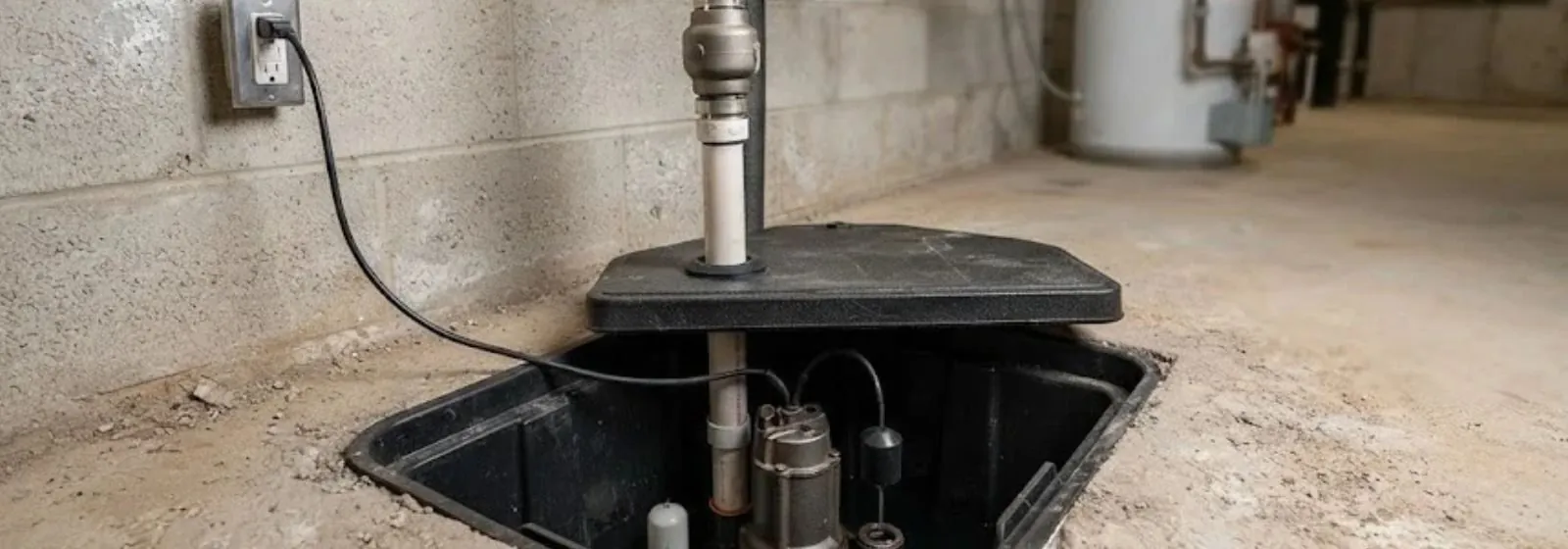
A sump pump that fails during a storm turns a damp basement into a flooded one in a short stretch of time. Sump pump installation and repair in Westfield, NJ means restoring or replacing the pump that moves groundwater out of the pit and away from your foundation. Our dispatch line runs 24/7, and the safest thing to do while you wait is to stay out of standing water and keep the electrical panel in mind.
Most failed pumps come down to a handful of causes: a stuck float, a lost power supply, a clogged intake, a failed check valve, or a pump that was too small from the start. This page explains each one, what backup options actually do, and what we check on a storm-night call.
The Basement Is Filling Right Now: What to Do While You Wait
Electricity and water in the same room are the main danger. Put safety ahead of saving belongings.
Do not wade in until power is known safe
If water covers outlets, a freezer, a furnace, or the panel, assume the wiring could be live. Stay on the stairs and keep children and pets out of the room.
Cut power only from dry ground
Switch off the basement circuits at the panel only if the panel is upstairs or in a dry area you can reach. If water is near the panel itself, call 911 or the electric utility instead of touching it.
Check the pit from a distance
Look at the pump from the stairs. Note whether the float is jammed against the wall, the lid is off, or the discharge pipe is dry. Do not reach in while the cord is plugged in.
Lift valuables and clear a path outside
Move boxes off the floor onto shelves or upstairs. If safe, check that the outdoor end of the discharge pipe is not buried in leaves, ice, or snow.
Why a Sump Pump Stops During a Storm
These are the failures we see most. Several can be fixed in one visit.
Stuck or tangled float
The float rises with the water and starts the pump. If it jams against the pit wall or its own cord, the pump sits idle while the pit fills.
Power loss
A tripped GFCI, a loose plug, or a neighborhood outage all stop the pump. A standard pump has no way to run without house power.
Clogged intake or impeller
Silt, gravel, and debris wear the pump or jam it. The motor hums, but water barely moves.
Failed check valve
The check valve keeps water in the discharge pipe from falling back into the pit. When it sticks, the pump cycles constantly and wears out sooner.
Blocked or frozen discharge
A pipe buried in debris, flattened by a mower, or frozen shut gives the pump nowhere to send water.
A pump that was never big enough
A pump sized for a drizzle struggles in a downpour. Pit size and pump capacity both matter, and we cover that further down.
Pit full and rising?
Stay out of standing water near outlets and the panel, then call the dispatch line.
Ida, July 2025, and What They Taught About Pumps
Tropical Storm Ida in September 2021 brought catastrophic flooding to Westfield, with a Union County rainfall rate of 3.65 inches per hour. In a July 2025 storm, flooding began around 5 p.m. after about an hour of heavy rain, and the Westfield area had more than six inches by 8 p.m. For a basement, that pace gives the pump almost no time to ramp up, so a free-moving float and a clear discharge matter more than a big motor.
Westfield sits among Rahway River tributaries, and Robinson's Branch runs through the southern part of town. In August 2022 the town council took up stream clearing near the North Euclid and Fairview tributaries at Mindowaskin Park, plus ongoing talks about Robinson's Branch flooding.
The council also dealt with an emergency repair of the Tamaques Way sewer pumping station. That is a municipal sewer system, not your sump, but it shows that pumps wear and fail under storm load. Test yours in dry weather, not on storm night.
Neighbors in Scotch Plains saw upwards of 10 inches of rain in Ida and flooded basements, so towns on both sides of the Westfield line share this exposure.
Source type: newspaper coverage of the storms and town council meetings
Repair, Replace, or Add a Backup
The right move depends on the pump's age, how it failed, and how often water reaches the pit.
| What we find | Likely fix | When replacement is smarter |
|---|---|---|
| Float stuck, pump otherwise strong | Free the float, reposition it, or swap the float switch | If the float has failed more than once, or the pump is old |
| Pump runs but moves little water | Clear the intake and impeller, check the discharge | If the impeller is worn or the motor is loud or hot |
| Pump cycles on and off with no water coming in | Replace the check valve and test the discharge for backflow | If the pump is already worn from short-cycling |
| Pump works, but power failed in a storm | Add a battery backup pump on its own float | If outages and heavy rain have already hit together |
| Pump keeps up in light rain but loses in heavy rain | Reassess pump capacity and the pit | Usually replacement with a larger pump or a second pump |
A used pump with signs of wear is rarely worth rebuilding in the middle of storm season.
Battery Backup and What It Really Covers
A battery backup is a second pump with its own float and battery, sitting in the same pit or a nearby one. When the main pump loses power or fails, the backup starts at a slightly higher water level. It does not turn a basement into a lake-proof room, and its run time depends on the battery size and how hard the water is coming in.
A water-powered backup is another type that runs from municipal water pressure and needs no battery. It uses water to move water and only works while the supply stays on. Each type has trade-offs, and we describe them in terms of your pit, not a brand.
A backup needs maintenance too. Test it a few times a year by lifting its float, and watch the battery's age. A backup that has never run is a guess, not a safeguard, and this is one more reason to book a test visit before the next big storm.
Check Valves, Discharge Routing, and Pit Sizing
The check valve is a one-way flap on the discharge pipe, and it matters more than most people expect. Without it, every pump cycle lets the pipe's water drain back into the pit, and the pump has to move the same water again. A valve that sticks closed can also strain the pump, so we test it by running the pump and listening for a clean seat.
Discharge piping should carry water outdoors and away from the foundation, so it does not just soak the ground next to the wall and return. Pipe that runs level or sags can hold water that freezes. We look for a pitch, a clear outlet, and a way to keep it from clogging. Where the discharge may go is a code question, so ask the Westfield construction office before any change.
Pits vary. A shallow, narrow pit makes a pump short-cycle, and a pit with no lid lets debris fall in. When we replace a pump, we check the pit's depth, its diameter, the condition of the liner, and whether the inlet holes still let water in. Sometimes a new pit is the real fix.
What a Storm-Night Call Looks Like
Our goal on the call is to get water moving, then fix the cause so you do not repeat the night.
- 1
Phone triage
The dispatcher asks how high the water is, whether the pump is running, and where the electrical panel sits. Water near the panel changes the plan.
- 2
Make the work area safe
We check the power source and the outlet type, and we work with a GFCI or isolated supply. If the panel is flooded, we will not go in until the hazard is cleared.
- 3
Diagnose the pump
We test the float, the impeller, the check valve, and the discharge pipe, in that order. Most failures show up in the first two.
- 4
Restore pumping
That may mean a new float switch, a cleaned intake, a replaced check valve, or a temporary pump while the permanent one is ordered.
- 5
Test under load
We fill the pit with a hose and watch a full cycle: start, discharge, shutoff, and no backflow. A pump that has not been loaded is untested.
- 6
Plan the next step
We tell you if the pit, the discharge, or the pump size needs work. If the water source is bigger than a pump can handle, our waterproofing page explains the larger fixes.
What Affects the Cost of Sump Pump Work
Prices follow what failed and what the next storm will demand of the system. We state the figure after diagnosis and before any parts are ordered.
- Repair or full replacementA float switch or check valve is a small job. A new pump, a new pit, or both is larger.
- Pump capacityHigher-capacity pumps cost more, and so do the discharge piping and electrical needs that go with them.
- Backup typeA battery backup, a water-powered unit, or a second pump each carry different parts and setup work.
- Pit and discharge conditionA cracked liner, a clogged outlet, or a long discharge run adds labor.
- Storm timingParts availability and scheduling are tighter when many homes lose pumps at once.
Water backup and groundwater seepage are often handled differently from sudden pipe discharge in homeowners policies, sometimes as a separate add-on, and wear is generally excluded. Read your policy before a storm, not during one. If you are unsure what applies, call (908) 357-1542 and we will describe what we found so you can pass it to your insurer.
Sump Pump Questions Westfield Homeowners Ask
Yes. The dispatch line is open 24/7 and sump pump failures during storms are routine calls. Tell us how high the water is and whether the panel is dry.
The usual causes are a clogged intake, a blocked or frozen discharge, a failed check valve, or a pump too small for the inflow. We check them in that order.
Pour a few buckets of water into the pit a few times a year and watch the pump start, empty the pit, and shut off. Test the backup the same way, and do it before storm season, not during one.
That is a code and municipal question, so ask the Westfield construction office. We route discharge outdoors and away from the foundation unless a rule says otherwise.
It keeps pumping for a time that depends on the battery and the inflow. In a long outage with steady rain, a backup can run down, so we size it to your pit and talk through the limits.
A pump handles water that reaches the pit. It does not stop water coming through walls or around a window well. Gutters and grading come first, and the waterproofing options cover the rest.
Water that appears at any time of year, even in dry weather, may be a pipe. Our leak detection tests can tell the difference.