

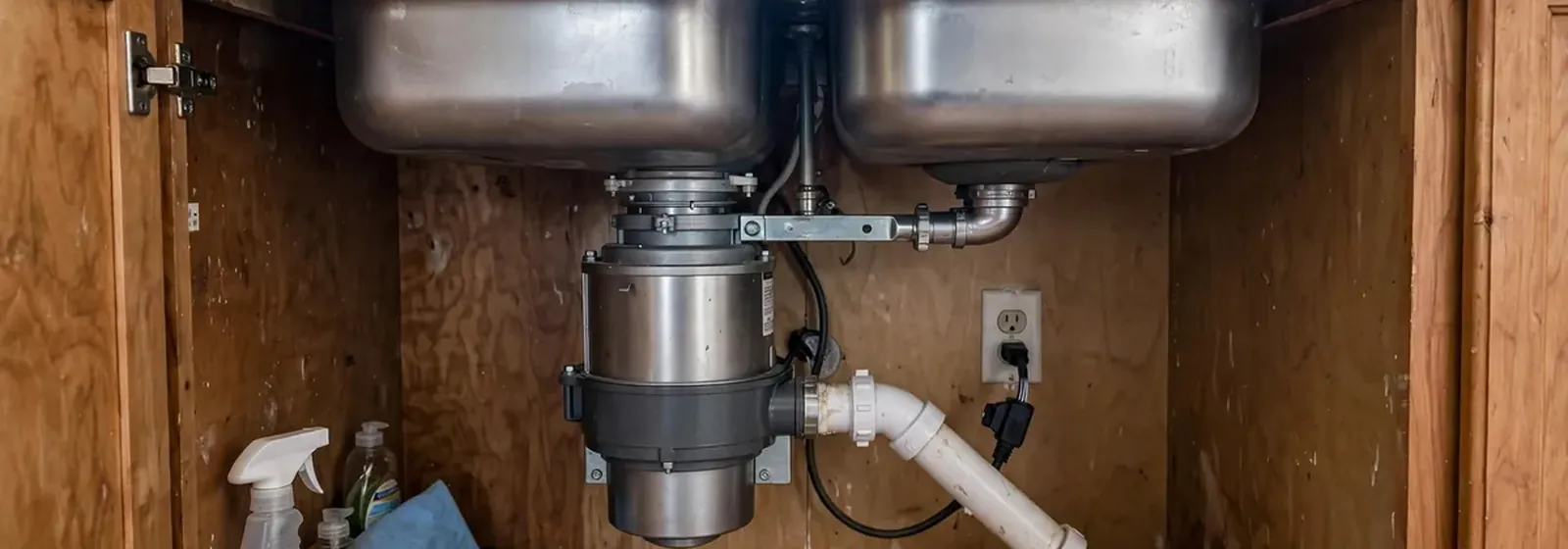
A garbage disposal repair in Westfield, NJ means freeing a jammed grinder, fixing a leak at the sink flange, drain outlet or dishwasher hose, or removing a failed unit and installing a new one. A leak under the sink or a backed-up double basin can stop a kitchen at dinnertime, so our 24/7 dispatch line takes those calls any hour.
Turn the disposal off at the wall switch, and if the unit is plugged into an outlet under the sink, unplug it. If water is leaking, empty the cabinet and put a bucket under the unit. Do not put your hand or a utensil into the disposal, even when it looks off, and call the dispatch line if the sink is full or the leak is steady.
What Is Safe for a Homeowner and What Is Not
Disposals injure people who assume the unit is off. This list separates the checks anyone can do from the work that should wait for us.
- Safe: switch the wall switch off and unplug the unit before touching anything around it.
- Safe: look into the hopper with a flashlight, and pull out visible debris with long tongs or pliers, never with fingers.
- Safe: press the red reset button on the bottom of the unit after it has cooled for a few minutes.
- Safe: use a hex key in the center of the bottom of the unit to rotate the shaft back and forth and free a jam.
- Not safe: any hand inside the hopper, even with the power off.
- Not safe: pouring drain cleaner or boiling grease in a unit that is already clogged.
- Not safe: disconnecting the drain outlet while the sink holds water.
- Call us: a leak from the body or the housing seam, repeated tripping of the breaker, or a smell of burning from the motor.
Humming, Jammed, Leaking or Silent: What Each Symptom Points To
The sound tells you what the unit is doing. This table matches what you hear and see with the likely failure.
| Symptom | Likely cause | What happens next |
|---|---|---|
| Hums but the blades do not move | Jam, often a bone, fruit pit or utensil | Clear with the hex key, then reset and test |
| Clicks, then silence | Motor overload or a tripped reset | Wait, press reset, check for a jam, replace if it repeats |
| Completely dead, no hum | No power, tripped breaker or burned-out motor | Check the plug and switch, test the outlet, replace if the motor is gone |
| Water at the sink flange | Failed mounting seal or putty | Remove the unit, reseal the flange and remount |
| Water at the discharge pipe | Loose connection or worn gasket | Tighten or replace the gasket and elbow |
| Water from the unit's body or underside | Cracked housing or failed internal seal | Replace the disposal, since the body cannot be repaired |
| Sink drains slowly with the disposal running | Clog in the trap or the line beyond it | Clear the drain line, not the grinder |
A leak from the body of the unit almost always ends in a replacement.
Disposal humming and stuck?
Switch it off at the wall switch first. Never reach into the hopper.
Jammed and Flooding the Sink: What to Do While You Wait
A disposal that will not run and will not drain can leave a sink full of dishwater. These are the steps that protect the kitchen.
Power off, plug out
Use the wall switch, then unplug the cord under the sink if there is one. A hardwired unit gets its breaker switched off.
Stop adding water
Skip the dishwasher, because it drains into the disposal. Hold off on sink use until the line is open.
Dip out standing water
Use a cup or ladle to lower the sink water so you can see the drain. Wear gloves, since the water carries food and grease.
Clear the cabinet
Move cleaners, bags and paper out from under the sink. If the unit is leaking, put a shallow pan under it and mark where the water is coming from.
How a Disposal Installation Goes, Start to Finish
Swapping a unit is a few hours of work when the old one comes out cleanly. This is the sequence we follow.
- 1
Turn off power at the breaker and confirm it
A disposal is wired or plugged in under the sink, so we cut power and test the circuit before loosening anything.
- 2
Disconnect the dishwasher hose and drain
Both sit on the disposal's side. We catch the water in the trap and check the hose for cracks.
- 3
Remove the old unit from the mounting ring
A twist on the lower ring releases the unit. We scrape off the old putty and inspect the sink flange.
- 4
Mount the new unit
The sink flange is sealed with new putty or gasket, locked into the mounting ring, and the unit is hung from it.
- 5
Reconnect drain, dishwasher and power
We set the discharge elbow at the right angle, knock out the dishwasher plug in the inlet if it was not done, and reconnect the electrical.
- 6
Run water and test for leaks
We fill the sink, run the disposal and check every joint with a dry paper towel before leaving.
Dishwasher Connections That Cause Mystery Leaks and Smells
The dishwasher drain hose connects to a nipple on the disposal. If the plug inside that nipple was never knocked out on a new unit, the dishwasher cannot drain. If the hose clamp is loose, water seeps at the connection and runs down the unit.
Dishwasher drain hoses are also routed in a high loop under the counter. A hose that sags allows dirty water to flow back into the dishwasher, causing a smell or a drain that stops partway through the cycle. We check the loop whenever we replace a disposal.
What Belongs in a Disposal and What Does Not
Fine in small amounts, with cold running water
- Soft scraps like cooked vegetables and fruit peels
- Small bits of soft food left on dishes
- Ice cubes occasionally, which scrape the grinder walls
- Citrus rinds in small pieces to freshen the unit
Keep out
- Grease, oil and fat, which cool and coat the drain line
- Coffee grounds, eggshell membranes and starchy rice or pasta in quantity
- Bones, fruit pits and corn husks
- Fibrous items such as celery strings, potato peels in bulk and artichoke leaves
- Anything non-food, including utensils and bottle caps
Older Westfield Kitchens, Old Drain Lines and the Sewer Connection
Housing data for ZIP 07090 shows about 37% of homes built in 1939 or earlier, so many kitchens have drain lines from several remodels. Some old kitchens still have an S-trap under the sink, which can siphon the water seal and let sewer gas into the room, and old drain lines can be narrow, rough inside and prone to catching grease. If the disposal runs and the sink still backs up, the problem is often downstream of the unit.
Westfield's sewer system connects to the Rahway Valley Sewerage Authority, and The Leader reported in February 2024 that sewer rates were rising. Grease that goes down the sink ends up in the lateral first, and clearing a lateral costs more than any disposal repair. Ask Westfield Public Works which section of your sewer line is the town's.
Source type: Census housing data summary and local newspaper coverage of sewer rates
What Affects the Price of Disposal Repair and Replacement
A jam is cheaper to clear than a leaking unit is to replace. You get a clear price before work starts. The factors below move the total.
- Repair versus replacementFreeing a jam or reseating a gasket costs less than a new unit, and a cracked body cannot be repaired.
- Unit size and motor typeA larger motor, a quieter model or a batch-feed design costs more to buy and sometimes needs a different mounting.
- Electrical setupA plug and outlet under the sink is a simpler swap than a hardwired unit or a missing switch.
- Drain conditionIf the trap, tailpiece or line behind the unit is clogged or corroded, that is added work.
- Hour of the callNight or weekend work can cost more than a daytime visit for the same job.
Homeowners policies often cover sudden accidental discharge, such as a hose that bursts, but not wear, corrosion or slow seepage, so read the policy. If water is on the floor now, call (908) 357-1542 and tell us where the leak is.
When the Clog Is Past the Disposal
New Jersey's plumbing subcode adopts the 2021 National Standard Plumbing Code. A like-for-like disposal swap is simple, but moving drains or adding a sink changes the scope, and permit rules vary by job, so ask the Westfield construction office before work starts.
We serve Westfield and nearby towns, including Scotch Plains. If the clog is deeper than the unit, our hydro jetting service and sewer camera inspection are the next steps.
Disposal Questions Westfield Kitchens Raise
Yes. A leak under the sink or a backed-up kitchen is answered on our 24/7 dispatch line, including nights and holidays. If the sink drains and the unit just hums, we can usually book a same-day appointment when available instead.
We still advise against it. Use tongs or pliers and a flashlight, and switch off or unplug the unit first. The hopper has sharp edges, and a switch or breaker can be flipped by someone else.
Usually it is jammed. Switch it off, use the hex key in the bottom center to turn the shaft, then press the reset button. If it still hums, the motor may be failing.
The line past the disposal is clogged. The grinder cannot fix that, and the line needs to be cleared.
It depends on the model, what goes down it and how often it runs. A unit that leaks from the body, jams often or trips the breaker is usually at the end of its life.
Often yes, if the sink has the standard drain opening and there is a power source. We check the trap arrangement and the electrical before pricing the job.
They freshen it, but they do not clean grease from the drain line. Cold water and a light mix of ice for scraping the grinder walls help more.