

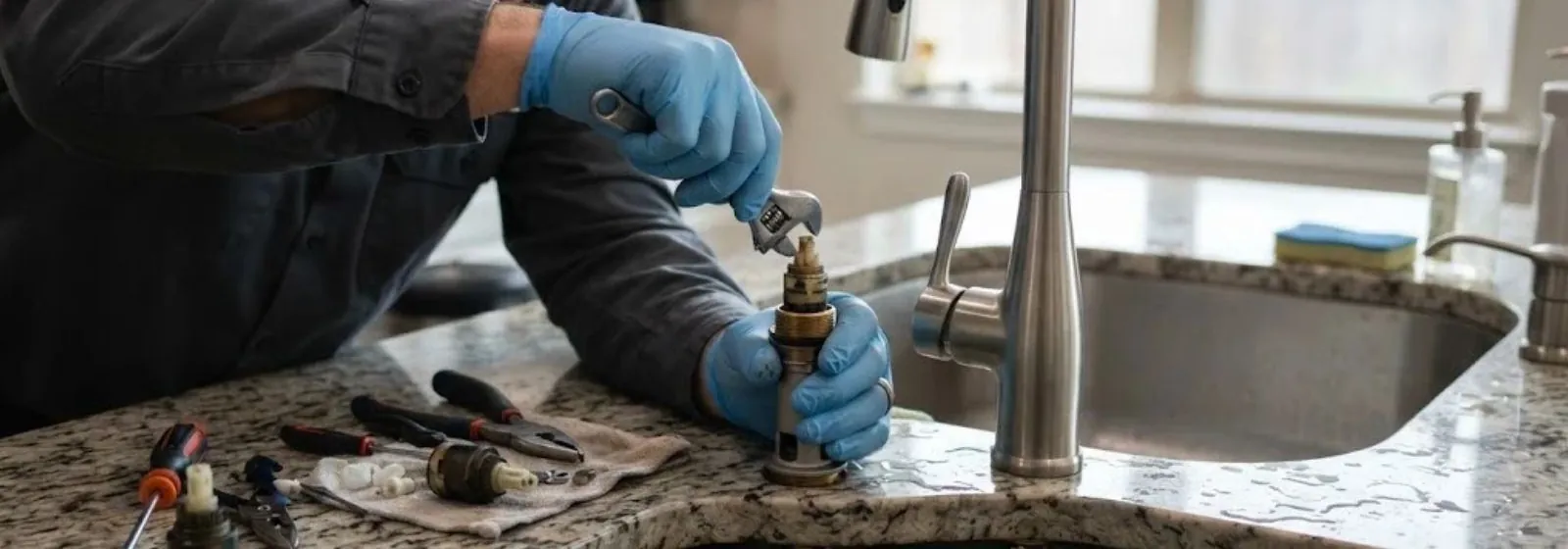
Faucet repair in Westfield, NJ is the work of stopping leaks and restoring flow at sinks, tubs, showers and outdoor spigots, either by replacing worn internal parts or by swapping the whole fixture. Most calls are slow drips and stiff handles that can be handled by appointment. A burst or broken supply valve under a sink is different, and we answer those on a 24/7 dispatch line.
If water is spraying or pooling and the fixture's own valve will not close, shut off the whole house at the main, which is usually near the water meter. Then open a low faucet to relieve pressure and call the dispatch line. A fixture line that has split inside a wall is a job for our burst pipe repair service. Same-day appointments are available when the schedule allows for everything else.
The Hidden Cost of a Shutoff Valve That Will Not Close
The faucet is rarely the expensive part. A repair that takes minutes on a working valve can take an hour on one that is frozen open, because the plumber has to shut off the whole house, drain the lines and sometimes replace the valve before touching the faucet. If the stop valve fails under pressure, the repair becomes a leak call.
Valve Failed and Water Is Running: First Moves
When a supply or stop valve gives way, the first two minutes matter more than the repair itself.
Find and close the main
The house main is usually near the meter or where the supply enters the basement or utility room. Turn a gate valve clockwise until it stops, and a lever valve a quarter turn across the pipe.
Open the lowest tap
A basement or outdoor spigot drains the lines and lowers the pressure feeding the leak. Keep the faucet at the leak open too.
Protect what is below
Move items off the cabinet floor, put a bucket under the leak and lay towels. If water is running into a ceiling, tell us.
Do not wrench the stem further
A packing nut or handle that is corroded can snap, and a snapped stem is harder to fix than a stuck one. Wait for us if the handle moves but does nothing.
Is water spraying?
Close the house main shutoff, then call. Do not keep cranking a stuck fixture handle.
Faucet Types, Why They Drip and What Fixes Them
Knowing which kind of faucet you have tells you what is failing inside. The fix depends on the design, not just the brand.
| Faucet design | Why it leaks | Typical repair |
|---|---|---|
| Compression (two handles, washer on the stem) | Rubber washer or seat worn by years of tightening | New washer and seat, or a new stem |
| Cartridge (single or two handle) | O-rings or the cartridge itself worn | Replace the cartridge |
| Ceramic disk | Seals at the bottom of the cylinder cracked or fouled with mineral grit | Replace the cylinder or seals |
| Ball (single handle, rounded cap) | Springs, seats or the cam wear | Rebuild kit, or replace the faucet |
| Wall-mounted tub or shower valve | Cartridge or stem failing inside the wall | Replace the cartridge or stem from the front, valve body only if it is damaged |
A leak at the handle usually points to a cartridge or packing. A leak at the spout points to a seat or a cartridge.
Repair the Faucet or Replace It
Repair if
- Only one part is worn and replacement parts are available
- The finish and body are in good shape
- The fixture is original to a house you want to keep authentic
- The drip is the only problem and the handles feel solid
Replace if
- Parts are no longer made for the faucet
- The body is pitted, cracked or leaking at the base
- You have had repeat repairs on the same fixture
- The finish is flaking or you want a different spout, a pull-down or a better flow rating
Pre-War Fixtures in Westfield Homes
Housing data for ZIP 07090 shows about 37% of homes built in 1939 or earlier, and about 28% built between 1940 and 1959. Many of those houses still have original two-handle faucets, tub spouts and shutoffs. They work, but their stems and seats are old designs that need specific parts, and a stop valve that has not moved in decades may fail the first time it is turned.
The town's preservation plan identifies historic districts such as Boulevard, Dudley Park and Prospect Street, and Kimball Avenue is the only locally designated district. If you live in an older home and want to keep a period faucet, tell us before we start. We can rebuild a compression faucet in many cases, but we will say plainly when the cost of repair beats the value of keeping it.
Source type: Census housing data summary and municipal preservation plan summary
Showerheads, Tub Spouts and Shower Valves
Shower and tub problems often start with a showerhead, but the cause can sit further back.
Weak spray
Mineral buildup clogs the nozzles. Soak the head in vinegar and brush the holes before replacing it.
Drip from the spout after shutting off
A tired shower cartridge or diverter often drips from the spout. Tub spouts with a pull-up diverter fail when the gasket wears.
Hot and cold mix wrong
A worn cartridge or a pressure-balance valve that has aged out gives sudden temperature swings.
Stiff or wobbly handle
The screw behind the cap may be loose, or the stem splines are worn. Shut the water before opening anything.
Stain on the wall or ceiling near the tub
A leak inside a shower wall shows up as a stain, soft tile or a musty smell, and the valve may be dripping behind the plate.
Outdoor Spigot and Hose Bib Repair Sequence
A hose bib that drips at the handle or inside the wall needs a different approach than a kitchen tap. New Jersey winters make it a seasonal job.
- 1
Disconnect hoses and check for freeze damage
A hose left on in winter holds water against the spigot. Cracks often show as a spray from the wall when the water is turned back on in spring.
- 2
Shut the interior stop and drain
Most older homes have a stop valve inside. If it will not close, we shut the main to work safely.
- 3
Replace the packing, washer or the bib
A drip at the handle is usually packing. A drip at the spout is the washer or seat.
- 4
Check the interior side
Water inside a basement ceiling or wall below the spigot means the line cracked behind the wall.
- 5
Consider a frost-free replacement
A frost-free bib puts the shutoff inside the heated wall so the exposed part drains. It must be installed with a slight downward slope.
What Changes the Price of Faucet and Valve Work
A drip is a small job and a failed stop valve is not. You get a clear price before work starts, and these are the things that shape it.
- Repair versus replacementRebuilding a faucet with a cartridge or kit costs less than a full replacement, and a premium fixture costs more to buy.
- Condition of the stop valveA frozen or leaking valve adds a second repair and may need the house shut off while we work.
- AccessUnder a vanity with a drain and supply lines, or in a tight wall behind a tub, takes longer than a bib on an open exterior.
- Wall or flooring damageLeaks from inside a shower wall can mean opening drywall or tile, which is separate from the plumbing.
- After-hours timingA night or weekend call for a stuck valve can cost more than a daytime appointment for the same fix.
Homeowners policies often cover sudden accidental discharge, such as a supply line that bursts, but not wear, corrosion or slow seepage, so read the policy before you rely on it. Photograph the area before you clean up. If water is moving now, call (908) 357-1542 and we will tell you what to close first.
Permits, Code and Where We Work
New Jersey's plumbing subcode adopts the 2021 National Standard Plumbing Code. Swapping a faucet is simple work, but moving a supply line or adding a fixture is a different job, and permit rules vary by job, so ask the Westfield construction office before work starts.
We serve Westfield and nearby towns, including Scotch Plains. If a stuck valve turns out to be a failing pipe, our leak detection service finds the source before walls are opened.
Faucet and Valve Questions We Hear
Yes. A stop valve that sprays, a supply line that fails or a shower valve that will not shut off gets answered on our 24/7 dispatch line, including weekends. A simple drip is better booked as a same-day appointment when available.
Internal parts have worn, such as a washer, a seat or a cartridge seal. The fix is usually a repair kit, but a pitted seat may mean replacing the faucet.
Only if you can shut off the water supply to the whole house first. Replacing a stop valve means cutting or unscrewing a pressurized line, and an old valve may leak when disturbed. We often change it during the same visit.
Slightly, because hot water wastes energy and can scald. Both can wait only if the leak is a slow drip and the handle still closes.
Often we can rebuild it or find a suitable replacement part. When parts are not available, we explain the options for a replacement with a similar look.
The pipe behind the faucet probably froze and cracked. Shut off the supply to that spigot and call, because the leak is inside the wall.