
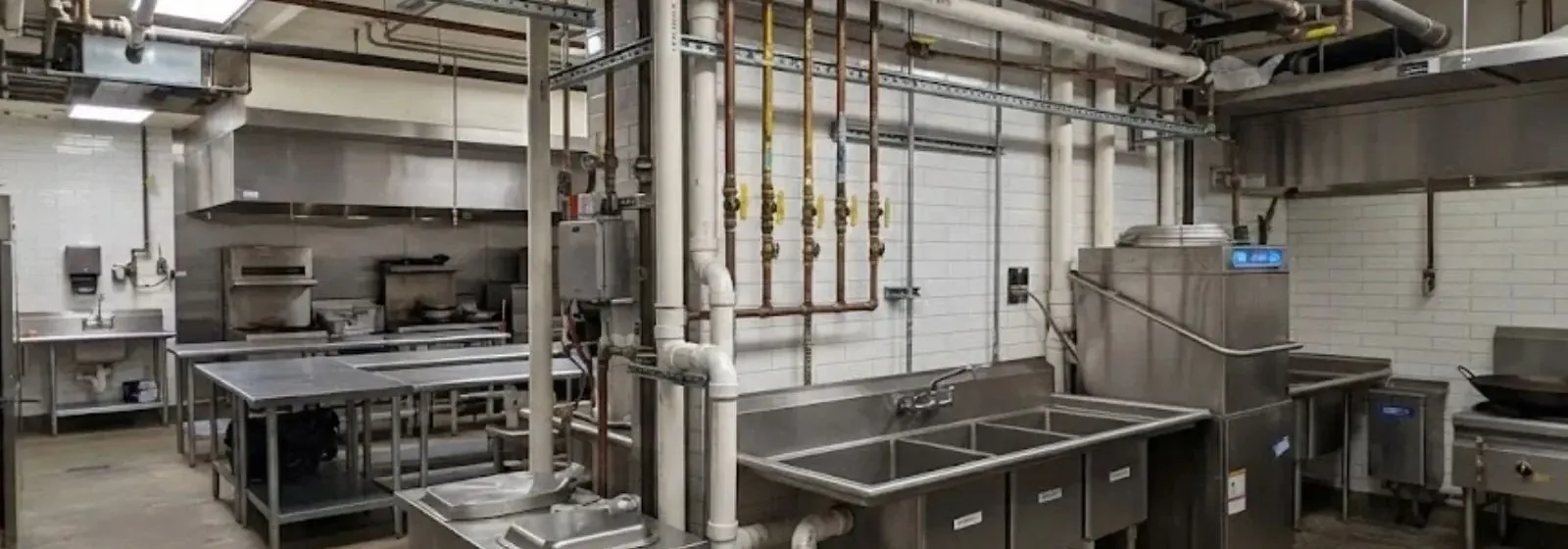
Commercial plumbing in Westfield, NJ means work on the water, drain, waste and vent systems of a business or multifamily building, where one failure can close a kitchen, a store floor or a whole office. We take these calls on a 24/7 dispatch line because a flooded back-of-house at 9 p.m. is a problem that gets bigger by morning.
If water is actively spreading, find the main shutoff for the building or for the affected tenant space and close it before you call. If you cannot find it, tell us and we will walk through where it usually hides. Same-day appointments are offered when available for planned work like grease trap service and backflow testing.
While You Wait: First Moves When a Commercial Line Fails
Staff and tenants usually reach for a mop first. These four moves protect the building and the people in it, and they give us what we need on the first call.
Close the nearest shutoff
Try the fixture stop, then the tenant or riser valve, then the building main. A valve that is stuck or leaks at the stem is worth telling us about.
Clear the floor and cut power at risk
Move stock, paper and electronics off the floor. If water is near outlets, panels or a walk-in cooler compressor, leave the breaker alone and call the building electrician.
Stop using the affected fixtures
A backed-up kitchen line gets worse every time a dishwasher drains or a restroom flushes. Post a sign and keep staff off those sinks.
Photograph and note the source
A few pictures and a note on which floor, which fixture and when it started help your insurer and help us plan tools and parts.
After-Hours Failures We See in Restaurants, Shops, Offices and Apartment Buildings
The building type tells us a lot before we arrive. These are the failures that most often lead to a night or weekend call.
Restaurant kitchen backup
Grease and food solids pack the line between the prep sink and the trap or main. Floor drains start bubbling at close, when the dish machine runs hardest.
Retail restroom overflow
A high-use public restroom flushes paper towels, wipes and trash that a residential toilet would never see. The blockage sits past the fixture and floods the floor.
Office riser leak
Water stains on a ceiling tile usually mean a failed joint or supply above. The wet spot is rarely under the leak.
Multifamily stack backup
When a shared drain stack clogs, the lowest unit floods first. Several tenants may call at once, and the answer is in the shared line, not in any one apartment.
Water heater or boiler failure
A storefront with no hot water can fail a kitchen or salon day. Commercial tanks and mixing valves are sized differently from home units.
Business down after hours?
Tell us the building type, the symptom and where the shutoff is. That is enough to start.
Landlord, Tenant or Property Manager: Who Calls and What We Need
Many commercial calls stall because nobody is sure who is allowed to approve the work. Your lease decides who pays, and we will not guess at it. We still need the same details.
| Who is calling | Typical first question | What helps us on the first call |
|---|---|---|
| Restaurant or shop tenant | Is this inside my space or in the building line? | Which fixture, where the floor drain is, whether neighbors are affected |
| Landlord or owner | Can you come while the tenant is away? | Access arrangements, a contact on site, building age and layout |
| Property manager | Can one visit cover several units? | Unit list, which stacks are shared, who approves work |
| Office manager | Can this wait until morning? | Is water spreading, is there a shutoff, are electronics at risk |
| Condo or HOA board member | Is this common area or unit owner? | Building age, which floor, a person who can open mechanical rooms |
Ownership of a line is a lease or governing-document question, not a plumber's call.
Downtown Westfield Buildings and the East Broad Street Main Break
Westfield's preservation plan identifies districts such as Prospect Street, mostly built between 1865 and 1910, close to the downtown core. Storefronts and upper-floor offices in buildings that old may have additions, patched drain lines and shutoff valves nobody has turned in years. Ask us to locate and exercise your valves during a planned visit, not during a flood.
On December 12, 2020, a New Jersey American Water main broke near 126 East Broad Street between Prospect and Elm Streets. About 20 commercial and 30 residential customers were affected, East Broad was closed, and repairs were expected to take about 16 hours. A business with no water for a full day needs a plan for restrooms, hand washing and dish service, so decide now who you would call and what you would shut off.
The Westfield train station on the Raritan Valley Line brings steady foot traffic past downtown shops and food counters. More customers means more flushing, more sink use and faster wear on valves and traps. Ask about a yearly look at restroom supplies and drains.
Source type: utility press release and municipal preservation plan summary
Planned Grease Trap Cleaning, Step by Step
Grease trap cleaning is scheduled work, not an emergency, though a skipped cleaning is how many kitchen emergencies begin.
- 1
Locate and open the trap
Under-sink units sit near the prep area. Larger in-ground interceptors have a cover that may be under equipment or a parking surface.
- 2
Measure what is inside
We look at how deep the grease cap and the settled solids are. A trap packed with solids needs cleaning more often than the calendar suggests.
- 3
Pump or bail out the contents
Water, grease and solids all come out, and the tank walls and baffles are scraped. Leaving the old layer behind defeats the cleaning.
- 4
Check the baffles, lid seal and outlet
A cracked baffle lets grease pass straight through. A bad lid seal lets odors into the kitchen.
- 5
Set a cleaning interval and log it
We suggest a schedule based on what we saw. Haulers, the water utility or the local authority may set their own records rules, so ask them what applies to you.
Backflow Testing: Keeping the Building's Water Out of the Public Supply
A backflow assembly sits on a line where dirty water could be pulled back into the public supply during a pressure drop. Restaurants, car washes, irrigation systems, boilers and some fire lines commonly have one. The assembly has check valves and relief parts that wear, so it is tested rather than assumed to work.
Testing involves isolating the device and reading pressure differences across its valves with a test gauge. If a part fails, the assembly is repaired or replaced and tested again. How often a test is required, and who receives the result, depends on your utility and local authority, so ask New Jersey American Water and the Westfield construction office before you book.
Floor Drains and Lift Pump Overflow
A floor drain is the last safety valve in a kitchen, a mechanical room or a basement. It fails in two ways: the trap dries out and lets sewer gas up, or the line behind it clogs and sends water back out. Pouring water into a drain that rarely gets used refills the trap, but a drain that backs up needs the line cleared.
A lift or ejector pump handles water from fixtures below the sewer level, such as a basement restroom. When the float sticks or the pump burns out, the pit fills and overflows onto the floor. Do not keep using the fixtures feeding that pit. Call us with the pit's condition and whether an alarm is sounding, and see our sump pump page for how related pumps work.
Commercial Leak Detection: What We Need to Know on the First Call
Commercial leak calls often end without a booking, and that is usually because the scope is large and access is hard, not because the leak is hidden. A meter that keeps turning in a building with six tenants, a slab, a roof unit and a fire line could be any of a dozen things. We would rather say so than send a crew with the wrong tools.
To help us decide, call the dispatch line and tell us the building type and age, what changed in the water bill or meter, which areas are wet, and who can give access to ceilings, mechanical rooms and the street valve. Tools include a pressure gauge, a moisture meter and a camera, but none of them shortens a job that needs walls opened. Our leak detection service explains the methods in more detail.
What Drives the Cost of Commercial Plumbing Work
We cannot give you a figure before we see the building, and we will not guess over the phone. You get a clear price before work starts. These are the things that move it.
- Access and building layoutA basement cleanout is quick. A drain buried under a kitchen line, a locked mechanical room or a ceiling that must be opened adds time.
- Size and type of the lineA 2 inch fixture line and a 4 inch building drain call for different equipment, crew size and time.
- After-hours timingNight and weekend work can cost more than planned daytime service. A scheduled grease trap visit usually costs less than the same job after a kitchen has shut down.
- Parts and code requirementsBackflow assemblies, grease interceptors and pumps vary by size and rating. Work must follow New Jersey's plumbing subcode, which adopts the 2021 National Standard Plumbing Code.
- Permits and coordinationSome jobs need a permit and an inspection, and permit rules vary by job, so ask the Westfield construction office before work starts.
Business and property policies often cover sudden accidental water discharge but not wear, corrosion or slow seepage, so read your policy and talk to your agent about business interruption. Take photos before cleanup. Call (908) 357-1542 with the building details and we will tell you what we can do and what we would need to see first.
Commercial Plumbing Questions from Westfield Businesses and Landlords
Yes. Our dispatch line is staffed 24/7, including nights, weekends and holidays. A kitchen backup, a burst supply line or an overflowing restroom gets handled the same night when a crew is available.
Give us the building type, the symptom and the shutoff status when you call.
You can call and tell us what is happening, and we can advise on shutting off water. Who approves and pays for work inside your space or in the building line depends on your lease, so check with your landlord or manager before authorizing repairs beyond stopping the damage.
Yes, and it is usually the better way. Send us the unit list, tell us which stacks and risers are shared, and name a person who can open mechanical rooms and units.
If water is coming up onto the kitchen floor, treat it as one. Stop using sinks and the dish machine, close what you can, and call. A slow drain that has not overflowed can usually be handled by a scheduled visit.
It depends on how much grease goes through it, and we measure the cap and the solids on each visit. Your hauler, the utility or the local authority may also set a schedule, so confirm what applies to you.
Many do, such as restaurants, irrigation systems and boiler feeds. Who requires testing and how often is set by your water utility and local authority. Ask them, then call us to book the test.
Large buildings often need access to several spaces, and a quick visit cannot answer the question. When that is the case we tell you honestly what the first step is and who needs to be on site.
We take calls across Westfield and nearby towns. Our Scotch Plains service page covers the neighboring township, and we ask for the building address when you call.