

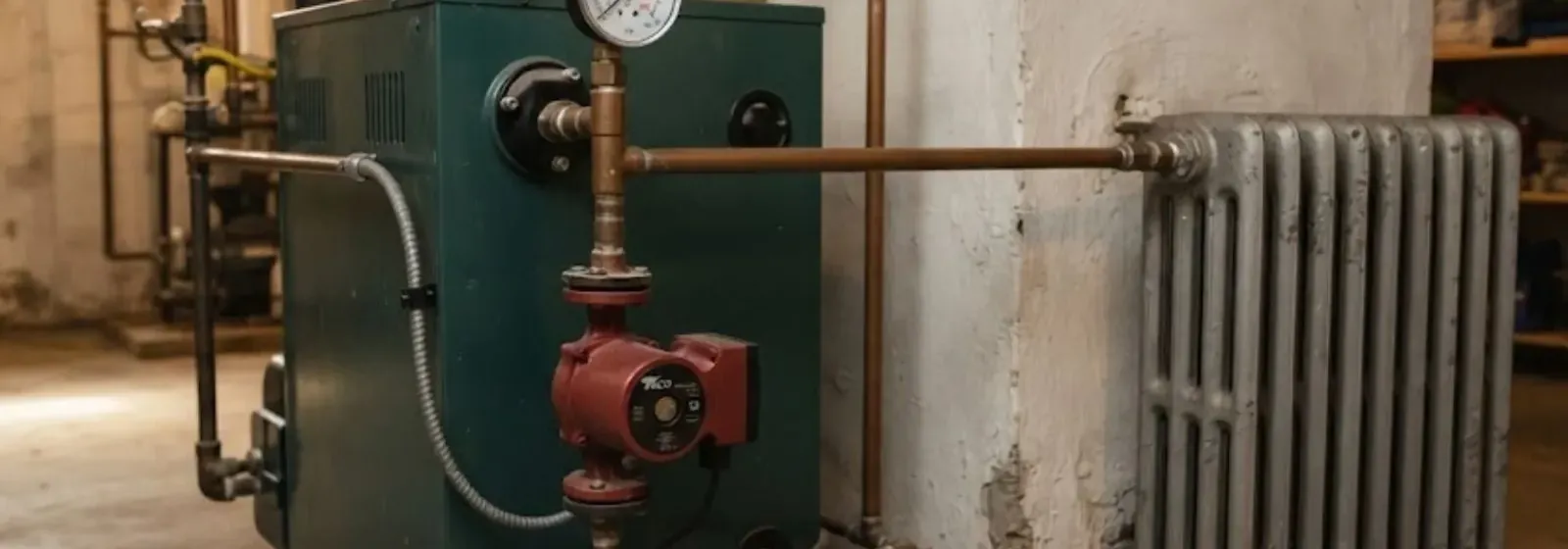
Boiler repair in Westfield, NJ covers hot water and steam boilers that stop heating, leak, lose pressure, short cycle, or lock out on a fault. When the house is cold, that is an emergency, and our dispatch line is open 24/7 for it. While you wait, check the thermostat and the boiler's power switch, and keep the heat in with doors closed and a space heater only if you can run one safely.
A boiler job is part plumbing and part heating controls, and we are straight about which part we do. We handle the water side: pressure, feed valves, relief valves, expansion tanks, circulators, zone valves, leaks, and piping. Burner, gas train, and oil burner work is done by licensed heating contractors, and we will say so on the phone.
No heat right now: five checks before you call
These take a few minutes and sometimes end the problem. Do not open the boiler cabinet.
- Thermostat set to heat, set several degrees above room temperature, with fresh batteries if it takes them
- The boiler's emergency switch (a red plate or a switch near the stairs) is on, and the breaker has not tripped
- The pressure gauge reads in the normal range on the dial, not near zero and not near the top
- Fuel supply: gas appliances on, or oil level above empty on the tank gauge
- A single press of the reset button if the manual allows it. If it locks out again, stop and call
Gas smell, fuel oil smell, or soot: leave, then call
If you smell gas, PSE&G's guidance is to leave the building immediately, move at least 350 feet away, and call 1-800-880-PSEG (7734) or 911. Do not use light switches, doorbells, matches, appliances, or a phone inside, and do not try to find the leak. Call us only after the house is cleared.
A strong fuel oil smell, black soot on or around the boiler, or a carbon monoxide alarm sounding also means get everyone outside and call 911. Never restart a boiler that has sooted or shown flame rolling out of the burner.
No heat tonight?
Check the thermostat, the power switch, and the pressure gauge, then call.
While you wait for the technician: four things to do
The aim is to protect the pipes and give the visit a head start.
Keep the pipes from freezing
In a deep cold snap, open cabinet doors under sinks on outside walls and let a faucet drip. A frozen line in a cold house turns a no-heat call into a burst pipe.
Note the gauges and the display
Write down the pressure, the temperature, and any fault code. Take a photo of the boiler's data plate.
Do not bleed or drain on a hunch
Opening valves randomly can drop pressure or flood the floor. Close the water feed valve only if water is actively leaking.
Clear the area
Make room around the boiler and the nearest radiators or baseboard so the technician can reach every valve.
What the symptom usually means
The cause often decides who can fix it. We mark which side each one falls on.
| Symptom | Likely cause | Who fixes it |
|---|---|---|
| Pressure drops to zero or climbs past the relief setting | Failed feed valve, waterlogged expansion tank, leak | Plumbing (us) |
| Boiler runs but radiators stay cold | Air in the system, failed circulator, stuck zone valve | Plumbing (us) |
| Water on the floor under the boiler | Leaking relief valve, weeping joint, cracked section | Plumbing (us), unless the heat exchanger is cracked |
| Turns on and off every few minutes | Oversized for the load, dirty sensor, low flow, bad thermostat location | Depends, often shared |
| Fault code and lockout | Ignition, flame sensor, pressure switch, vent block | Heating contractor, usually |
| Steam boiler: banging or no steam | Low water cutoff, dirty water, pitched pipes, bad air vents | Mixed, we handle water level and piping |
Final answers depend on testing, and we tell you which category your boiler falls into.
Hot water boilers and steam boilers fail differently
A hot water boiler heats water and pushes it through a closed loop of baseboard, radiators, or in-floor tubing. It runs under moderate pressure, controlled by a fill valve and an expansion tank, so the common faults are pressure faults. Low pressure suggests a leak or a stuck fill valve, and high pressure after heating suggests a waterlogged expansion tank.
A steam boiler boils water to make steam that rises to radiators and then condenses back down. Its faults are about the water level, not the pressure, since the pressure is only a pound or two. A failing low water cutoff, a dirty sight glass, or a clogged radiator vent produces banging, uneven heat, or a shutdown. The two systems look similar from the street and are nothing alike inside.
Short cycling, lockouts, and pressure swings
Short cycling means the boiler fires, shuts off in a couple of minutes, and fires again. The cause may be a boiler too large for the house, a thermostat in a draft, a zone with a stuck valve that holds back flow, or an aquastat set too close to its limit. Each wears the burner and wastes fuel.
A lockout is the boiler saying it detected a fault and will not try again until reset. Resetting once is reasonable. If it locks out again, something is wrong with ignition, flame sensing, or venting, and repeated resets only stress the equipment. Call the dispatch line and tell us the code. We will say plainly whether the fix is on the plumbing side or needs a heating contractor.
Plumbing side and heating side: what a visit can and cannot cover
What we handle
- Fill valves, pressure reducing valves, and relief valves
- Expansion tanks and air elimination
- Circulator pumps and zone valves
- Leaking pipes, fittings, and boiler drains
- Hot water boiler pressure and steam boiler water level problems
- Tying in water and drain lines for a boiler swap
What a heating contractor handles
- Burner, nozzle, and oil burner service
- Gas valves, the gas train, and combustion analysis
- Control boards and ignition modules
- Heat exchanger replacement
- Chimney and flue work specific to oil or gas heating equipment
How a no-heat boiler call runs
The order below keeps the first part of the visit about information, not parts.
- 1
Phone triage
On the call we ask about the type of system, the pressure, any code, and any smell, so we know what to bring.
- 2
Safety first
Gas smell, soot, or a carbon monoxide alarm ends the visit before it starts. We do not work around those.
- 3
Read the system
Pressure gauge, aquastat, water level or sight glass, circulator, and zone valves. We feel for flow in each loop.
- 4
Sort the fault
If it is on the water side, we fix it. If it needs a burner or gas train, we tell you the fault and the type of contractor to call.
- 5
Restart and watch
We bring the system back up, check the pressure through a heating cycle, and confirm that heat reaches the far zones.
Annual boiler service: what actually gets checked
A yearly visit before the heating season catches faults while they are still cheap to fix. On the water side we test the relief valve, check the expansion tank pressure, inspect the fill valve, and bleed air from the loops. A stuck relief valve or dead expansion tank will fail on the first cold week if nobody has touched it since spring.
Burner cleaning and combustion testing belong to the heating contractor, and a good annual service includes both. If you want one visit to cover both, say so when you call and we will explain how to line them up. Annual service also follows the maker's published service guidelines for your boiler model. New Jersey's plumbing subcode adopts the 2021 National Standard Plumbing Code. A replacement or new piping run may need a permit, so ask the Westfield construction office.
Old Westfield houses and the question of age
The town's Historic Preservation Master Plan Element, adopted April 1, 2024, identifies districts such as Dudley Park (mainly 1880s to 1920s) and Boulevard (1880s to 1915). Median build year in ZIP 07090 is about 1953. That is context about the housing stock, not a claim about how your house is heated.
If your home is from either era, find out what kind of boiler it has, how old it is, and whether the radiators or baseboard are original. Systems in older houses are often altered over the decades, with zones added or radiators removed, which changes how air and water move. Tell us what you see, and we will start from there. If a leak has already turned into a split line, see burst pipe repair.
Source type: town historic preservation plan summary and Census ACS housing data
What drives the cost of a boiler repair
A boiler repair can be a small valve or a pump swap, and it can be a new boiler. We cannot name a figure before we have seen it, but we give a clear price before any work starts, and we tell you if the right answer is a contractor.
- The part that failedA feed valve or relief valve is a smaller job than a circulator, a zone valve manifold, or a section of leaking main.
- System type and layoutSteam systems, multiple zones, and boilers in cramped utility rooms take more time.
- Age and condition of the boilerA boiler near the end of its life may need more than one repair, so the conversation shifts to replacement.
- Draining and refillingSome repairs mean draining part of the system and refilling it, treating the water, and purging air.
- After-hours timingA cold-night emergency visit is scheduled differently from a booked daytime visit.
A burst heating line that floods a room may be covered as a sudden event, but a boiler that simply wore out usually is not, so read the policy. If the system is down tonight, call (908) 357-1542 and tell us what the gauges show.
Boiler questions from Westfield homes
Yes, cold nights and weekends are exactly when these calls come in, and we book same-day appointments when available. Tell us the system type, the pressure, and any code. We will say plainly what a plumbing visit can cover and when a heating contractor is the right call.
A slow loss points to a leak somewhere in the loop, a stuck relief valve, or a failed fill valve. If the leak is hidden in a wall or slab, leak detection is how we trace it. A fast loss and a wet floor point to an active leak. We check the relief discharge, the boiler drain, and the visible piping first.
Trapped air, a failed circulator, or a stuck zone valve are the usual suspects on hot water systems. On steam, check for clogged radiator vents or low water. The boiler is making heat that is not reaching the rooms.
Those jobs belong to a licensed heating contractor. We handle the plumbing side, and we tell you on the phone which side your problem sits on.
Reset it once if the manual allows. If it locks out again, stop, note the code, and call. Repeated resets can damage equipment.
A steady leak is, because water damage grows by the hour and a boiler that loses water can overheat. Turn off the boiler's switch, close the water feed valve, and call. Slow drips are less urgent but should not wait weeks.
Yes, we serve Westfield and nearby towns. Our Scotch Plains page covers that area. The same cold-night rules apply there.