

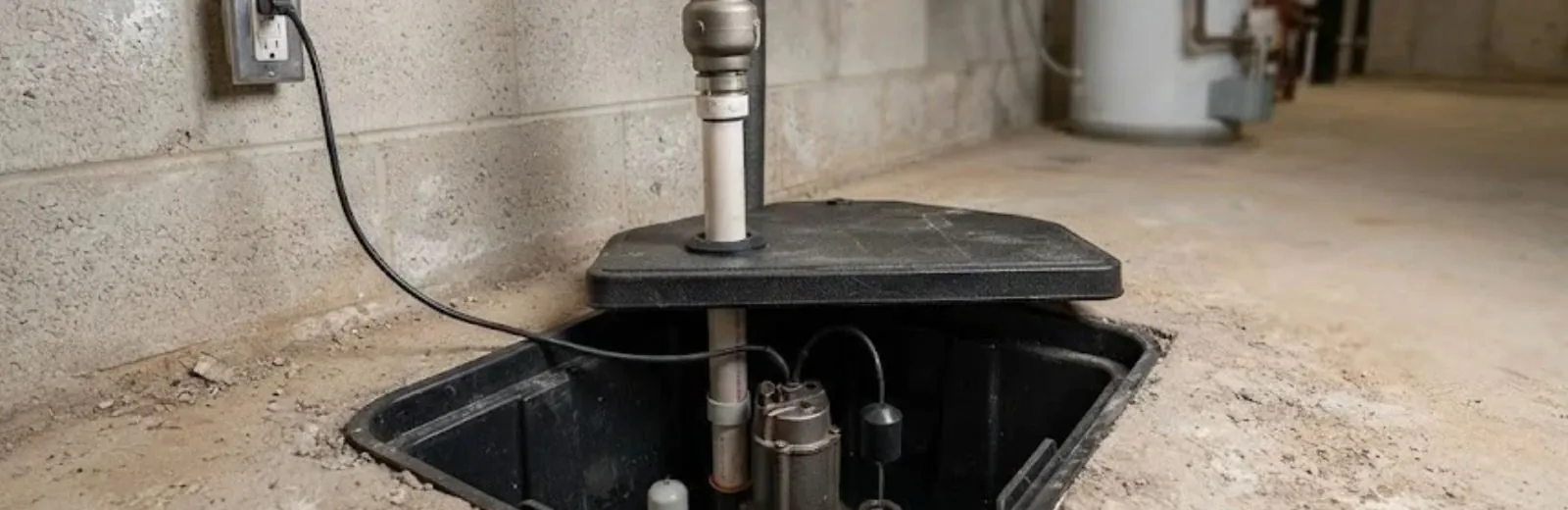
Sump pump installation in Westfield, NJ means building a small system: a pit that collects groundwater, a pump that lifts it, a check valve that stops backflow, and a discharge line that carries the water away from the house. Each piece has choices that matter, and the choices depend on how fast water arrives at your foundation.
This is a planning guide, not an emergency page. It covers pump types, the pit, discharge routing, battery backup, alarms, and testing, and it marks the parts that are plumbing and electrical work for licensed professionals.
Start With the Pit, Not the Pump
The pit is a basin set into the basement floor, usually a plastic or fiberglass liner in a hole cut through the slab and lined with gravel. Water reaches it through the gravel bed or from drain tile around the footing. The pit's size sets how often the pump cycles: a small pit fills fast and makes the pump start and stop often, which wears it out.
A lid keeps debris and children out, and a sealed lid helps with radon and humidity. Before cutting concrete, a contractor should know where the footing drains run and where the main drain and utility lines are. Breaking the slab is the messy, heavy part of the job, and a mistake there is hard to undo.
Pedestal or Submersible: Choosing the Pump Type
Both lift water. They differ in noise, lifespan, and how they handle debris.
| Feature | Pedestal pump | Submersible pump |
|---|---|---|
| Motor location | Above the pit on a column | Sealed inside the pit, underwater |
| Noise | Louder, heard in the room | Quieter, muffled by the water |
| Fit | Narrow or shallow pits | Standard pits, deeper basins |
| Debris tolerance | Fair, if the intake is screened | Often better with a strainer and clean pit |
| Service access | Easy to see and reach | Must be lifted out of the pit |
| Typical use | Occasional, lighter duty | Frequent or heavy-duty use |
Capacity is a separate question. Size by how much water arrives, not by the horsepower label.
Pump already failed?
This page is for planning a system. For a pump that quit during a storm, see the repair page.
The Check Valve and the Discharge Line
A check valve sits on the discharge pipe just above the pump. It lets water out and stops the pipe's contents falling back into the pit when the pump shuts off. Without one, the pump re-lifts the same water over and over. Pick a quiet, spring-type or flapper-type valve, and make sure it can be reached.
The discharge line should run to a spot the town allows, well away from the foundation, and should slope downhill to the outlet.
Do not connect a sump discharge to a sanitary sewer line or a house drain, since clear groundwater can overload that system. Ask the Westfield construction office and Public Works where discharge may go on your property before the line is run. A line that freezes shut gives the pump nowhere to send water, so keep the outlet open and sloped to drain.
The Installation Sequence in Plain Order
This is the order a contractor follows. The slab work, the plumbing connections, and the electrical supply are not DIY work.
- 1
Locate and plan
Mark the sump location with room for the pump, the discharge route, and an outlet on a dedicated GFCI-protected circuit. Call 811 before any digging outside.
- 2
Cut and excavate
Cut the slab, dig the pit to depth, and set gravel at the bottom. Test that water actually enters.
- 3
Set the liner and pump
Place the liner level and backfill. Set the pump on a firm base, not on bare dirt.
- 4
Plumb the discharge
Connect the pipe, check valve, and a small relief hole if the manufacturer calls for one. Run it to the approved outlet.
- 5
Power and test
Plug into the protected outlet, lift the float, and run water in. Confirm the pump starts, empties the pit, and shuts off.
Backup Power, Alarms, and a Second Pump
Storms that flood basements often knock out power. A single pump is not enough in those hours.
Battery backup pump
A second, battery-driven pump sits in the pit and takes over when the main pump or power fails. The battery needs care and replacement on a schedule.
Water level alarm
A high-water alarm warns you before the basement floods. Choose one you will actually hear, or one that texts.
Dual-float setup
A second float starts a backup pump higher than the main one. It runs only when the first has failed or been overwhelmed.
Generator option
Some homeowners power the pump from a generator. Run it outdoors, never in a basement or garage.
What Ida, the July 2025 Storm, and the Town's Pumping Station Tell You
Tropical Storm Ida in September 2021 hit Westfield with catastrophic flooding, and the Union County rainfall rate was 3.65 inches per hour, according to The Leader. In a July 2025 storm, flooding began around 5 p.m. after about an hour of heavy rain, and the Westfield area had more than six inches by 8 p.m. A pump sized for ordinary storms may be overrun at those rates, so ask about capacity, a backup pump, and an alarm.
At an August 2022 council meeting, as reported by Patch, the town took up stormwater actions that included stream clearing near the North Euclid and Fairview tributaries at Mindowaskin Park and an emergency repair of the Tamaques Way sewer pumping station. That station is a municipal sewer facility, not a household sump. Your sump system protects your basement only and does not replace the town's work. Treat town drainage projects as separate from your own plan.
Source type: newspaper coverage of storms and town council meetings
Testing, Maintenance, and When to Call
Test before the wet season and after any heavy storm. Pour a bucket of water into the pit until the float lifts, then watch the pump start, empty the pit, and shut off. Check the discharge outlet for flow, listen for grinding, and look for a pump that runs without moving water. Test the battery backup by unplugging the main pump and see that the backup runs.
Call a licensed plumber for any work on the slab, the discharge piping, and the check valve, and an electrician for new circuits. Our sump pump service covers installation and repair, and the waterproofing page explains what to do if water enters through walls rather than the pit. We serve Scotch Plains as well. Call our 24/7 dispatch line to plan a system.
Sump Installation Questions
Test before the wet season and after major storms, and any time the pit looks unusually full. A pump that rarely runs is the one most likely to be stuck.
Do not. Ask the town where discharge may go on your property, since sump water overloads sanitary systems.
They do different jobs. The backup keeps water moving when the main pump fails, and the alarm tells you something is wrong.
No. It is a municipal sewer station. Your sump is a private system that protects your own basement.
Setting a pump in an existing pit is within reach for some homeowners. Cutting the slab, connecting discharge piping, and electrical work should be done by licensed professionals.
Installation is planned work. Our dispatch line runs 24/7 for failures in progress, and same-day appointments are available when possible.