

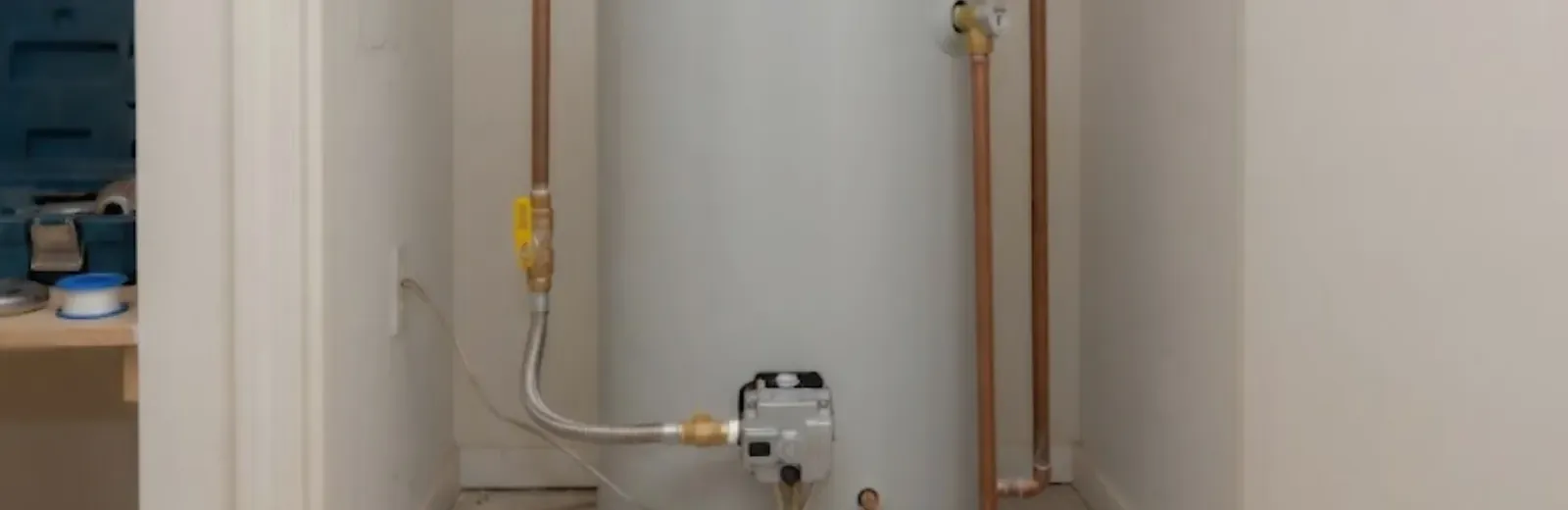
Low hot water pressure after a water heater replacement in Westfield, NJ almost always comes from something changed during the swap: a valve not fully open, debris knocked loose in the pipes, a connector that kinks, or a fitting that restricts flow. If cold water at the same faucet runs strong and hot does not, the problem sits between the cold inlet of the heater and the hot side of the fixture.
This guide gives the likely causes in the order worth checking, a table that separates one-fixture problems from whole-house ones, and the questions to put to the installer before anyone opens a wall.
Where the Weak Flow Shows Up, and What That Tells You
Test the hot side at the kitchen faucet, a bathtub, and the farthest sink. The pattern narrows the cause fast.
| Pattern | Most likely cause | First check |
|---|---|---|
| Hot weak at every fixture, cold strong | Partly closed valve, kinked or small connector at the heater | Heater shutoff valves and flexible connectors |
| Hot weak at one or two fixtures only | Clogged aerator or faucet cartridge | Unscrew the aerator and look for grit |
| Both hot and cold weak after the swap | Main shutoff not fully open, or a pressure problem upstream | Main valve and meter valve position |
| Hot starts strong then fades | Debris moving into a screen, or a failing mixing valve | Check screens and any mixing valve on the heater |
| Hot fine, but water hammers or pressure seems erratic | Missing or waterlogged expansion tank | Ask the installer about thermal expansion |
| Hot pressure low only in the shower | Shower valve cartridge or restrictor | Inspect the shower head and valve |
Test every fixture before deciding. A single weak faucet rarely means a heater problem.
Cause One: A Valve That Is Not All the Way Open
Most plumbers close the supply valves to swap a heater, then reopen them. A gate valve opened a quarter turn short, or a ball valve left slightly off the handle line, can cut flow without a leak anywhere. Check the cold inlet valve at the heater and the main shutoff near the meter. The handle on a ball valve should run along the pipe when open.
Older gate valves in pre-war basements can also fail internally, where the wheel turns but the gate does not follow. If a valve feels loose or spins without resistance, do not force it. That calls for replacement by a licensed plumber.
Hot weak, cold fine?
That split points to the heater side of the system, not the street supply.
Causes That Show Up Right After a Swap
These are all common, and most are simple to correct once found.
Debris in aerators and screens
Draining and refilling shakes sediment and pipe scale loose. It gathers in faucet aerators, shower screens, and appliance inlet screens.
Kinked or undersized flexible connectors
The braided hoses between the heater and the house piping can kink if pushed into a tight corner, or may be a narrower bore than the old connection.
A mixing valve or flow restrictor
Some heaters have a tempering device on the outlet. A restrictor or a clogged mixing valve cuts flow on the hot side only.
Dip tube orientation
The cold inlet tube inside the tank directs cold water down. If it is installed wrong or damaged, hot output can seem weak or lukewarm. A technician checks this when output is wrong.
Air in the lines
After the tank refills, trapped air can make faucets sputter. Opening the highest hot tap briefly usually purges it.
Sediment from the old connection
Disturbing old fittings and drained lines can stir rust flakes and mineral scale into the new tank's outlet and the hot piping.
A Short Diagnostic Path You Can Follow
Work through these in order. Stop at any step that involves gas, the flue, or cutting pipe.
- 1
Compare hot and cold at the same faucet
Fill a quart container from each side and time it. If hot takes noticeably longer, the problem is on the hot side.
- 2
Clean the aerator
Unscrew it, tap out grit, and rinse. Run hot with it off. If flow comes back strong, you have found it.
- 3
Open the highest hot tap
Let it run for a minute to clear air. Then check the other fixtures.
- 4
Look at the heater connections
Check that valves are fully open and the braided lines are not folded. Do not unscrew fittings under pressure.
- 5
Check the expansion tank
Look for a small tank on the cold supply. Ask the installer what pressure it was charged to. Tank pressure issues are a plumbing job.
After the East Broad Street Main Break: Sediment and Air in Westfield Lines
On December 12, 2020, a New Jersey American Water main break near 126 East Broad Street, between Prospect and Elm Streets, affected about 50 customers, 20 commercial and 30 residential, according to the utility's press release. After work on any water main, sediment and air can reach home plumbing, and aerators and screens are the first things to clog. If you had low pressure after neighborhood main work, clean the aerators before blaming a new heater.
Pressure on the street side is your utility's to answer. Ask New Jersey American Water whether there has been recent main work near your address, and what typical pressure is in your area. Compare that to what you measure at an outdoor spigot with a pressure gauge. The utility's numbers belong to the utility. Do not guess them.
Source type: utility press release (New Jersey American Water)
What You Can Check Versus What Needs the Installer
Homeowner checks
- Cleaning aerators and shower screens
- Confirming hot and cold at each fixture
- Looking that valves are fully open
- Opening a hot tap to purge air
- Writing down when the weakness began
Installer or licensed plumber
- Replacing gate or ball valves
- Re-running or resizing connectors
- Setting or replacing the expansion tank
- Checking the dip tube or mixing valve
- Anything involving gas, flue, or cutting pipe
Questions to Put to Whoever Installed the Heater
Ask whether the shutoff valves were fully reopened and the connectors checked for kinks. Ask what size the new connectors are compared with the old ones. Ask whether an expansion tank was installed, and whether pressure was checked afterward. Ask what the incoming pressure was at the time.
A reasonable installer will return to look at a flow problem that started with the swap. For help from us, see our water heater replacement and installation pages for how we handle the connections. If the weakness persists after the checks, call our 24/7 dispatch line, and we will test flow on both sides. We cover neighbors in Scotch Plains too.
When to Call a Pro
Call if hot pressure is low at every fixture after cleaning aerators, if you hear hammering, if a relief valve drips, or if a valve will not turn. Call at once if you smell gas or see a leak at the heater. Valve and connector work falls under New Jersey's plumbing license rule, so it is not a DIY task.
Pressure Questions After a Heater Swap
Some sputtering and air is normal. Steady weak flow that does not improve after purging air is not.
A shower head screen or cartridge may be clogged. Unscrew the head and rinse it, and ask whether the shower valve was disturbed.
Tank size affects how long hot water lasts, not how hard it flows. Pressure comes from the supply and piping.
It more often causes pressure spikes, banging pipes, or a dripping relief valve. Ask the installer whether one is needed.
Clean aerators and screens at your faucets, since they trap debris first. Ask New Jersey American Water about recent work and pressure.
Our dispatch line runs 24/7. A weak flow can usually wait for a daytime visit, though same-day appointments are available when possible.