

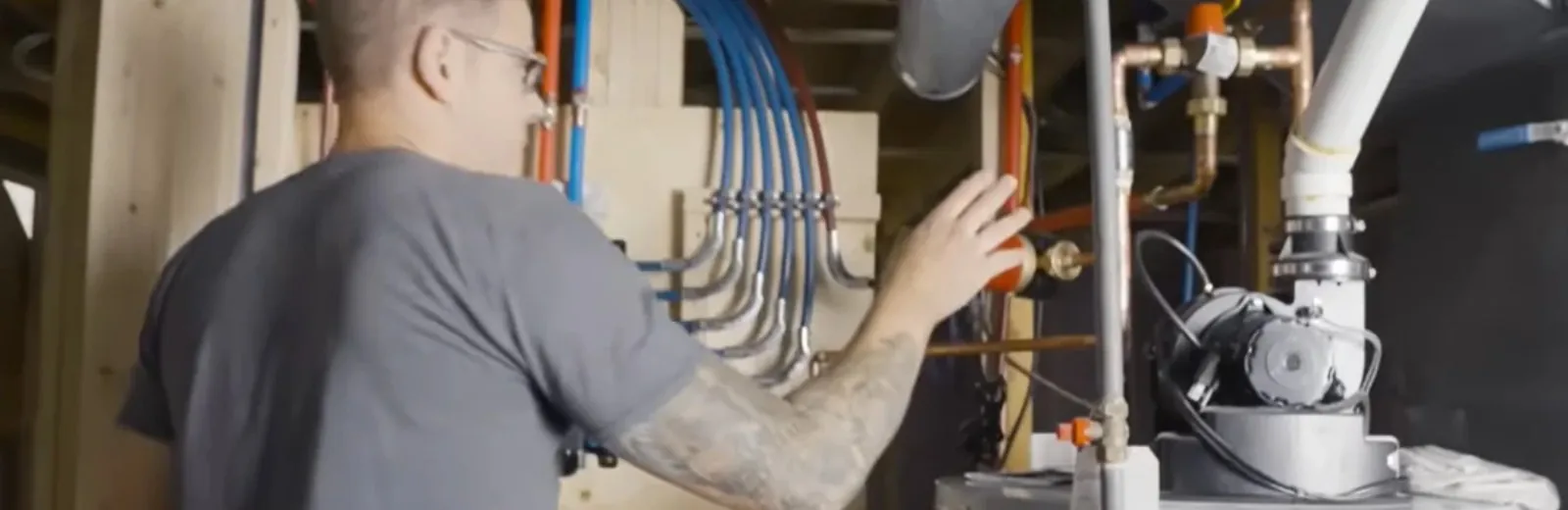
Gas water heater replacement cost in Westfield, NJ is not a single number, because the final invoice is built from six or seven separate decisions about the tank, the vent, the gas connection and the paperwork. A gas water heater is an insulated steel tank with a burner underneath and a flue above that carries exhaust out of the house, so the price follows what has to change around the tank as much as the tank itself.
This guide leaves out figures on purpose, because a price given without seeing your basement is a guess. It shows what moves a quote, how to read an itemized one, and how age and symptoms should tip you toward repair or replacement. If you ever smell gas, leave the house first and read the safety box below.
What Moves a Gas Water Heater Quote
Each row below is a place where two houses can end up with very different totals for the same brand of heater.
| Line item | What it covers | Why it changes the total |
|---|---|---|
| Tank size | Gallon capacity and how fast the burner reheats | Bigger tanks and faster recovery cost more to buy and may need a larger gas supply |
| Efficiency | Standard burner versus higher-efficiency or condensing designs | Efficient models cost more up front and may need different venting |
| Venting | Flue pipe, draft hood, connectors, or a powered or sealed vent | A new type of vent means new pipe, a new route, and more labor |
| Gas connection | Shutoff valve, flexible connector, sediment trap, line size | A worn shutoff or an undersized line adds parts and time |
| Expansion tank and valves | Thermal expansion tank, relief valve, discharge pipe | Needed in some homes and not others, so ask why it is on or off the quote |
| Permit and inspection | Paperwork and the municipal inspection visit | Rules vary by job, so the quote should say who handles it |
| Haul-away and access | Removing the old tank and carrying it out | Narrow basement stairs and tight closets take longer |
Two quotes only compare fairly when every row above is either included or clearly left out.
Reading an Itemized Quote Line by Line
Start with the model and capacity. A quote that says only 'gas water heater' tells you nothing about what you are buying, so look for gallons, an efficiency description and a warranty length for the tank. Then check whether the warranty covers parts only or labor too, since those are two different promises.
Next, find the vent and gas lines. A good quote names the new vent connector, the gas shutoff, the flexible gas connector and the sediment trap if one is added. If a line says 'misc. materials' with no detail, ask what is in it.
Finally, check what is not there. Permit handling, an expansion tank, a drain pan and disposal of the old unit are the usual omissions. Our water heater replacement quotes list these items separately for exactly this reason, and you can ask any plumber to do the same.
Smell gas?
Leave the house and call PSE&G or 911 before you call a plumber.
Repair or Replace: Reading Age and Symptoms
Lean toward repair
- The heater is under about eight years old and the fault is one part, such as a thermocouple, gas control valve or thermostat
- The tank is dry, with no rust-colored water and no moisture at the base
- The burner lights and holds, but water temperature is uneven
- Anode rod and sediment are the only real complaints, and a flush helps
Lean toward replacement
- Water is seeping from the tank seam or the bottom, because a leaking steel tank cannot be patched
- The unit is past roughly 10 to 12 years and needs a second repair in a short span
- Hot water runs rust-colored and the tank rumbles from heavy sediment
- Flue gases or soot appear around the draft hood, which points to a venting or combustion problem
How to Collect Quotes You Can Actually Compare
A little preparation keeps every bidder pricing the same job.
- 1
Read the data plate
The label on the tank shows capacity, fuel type and a serial number that usually encodes the build date. Photograph it.
- 2
Photograph the setup
Take wide shots of the flue pipe, the gas line, the shutoff valve and the path from the basement door to the tank.
- 3
Say what changed in your household
More people or a new soaking tub means a larger tank may be worth pricing. Fewer people may mean a smaller one.
- 4
Ask each plumber for the same scope
Request the vent, gas fittings, expansion tank, permit handling and haul-away as separate lines.
- 5
Ask who pulls the permit
The answer should be the licensed plumber doing the work, not you.
Safety First: If You Smell Gas
PSE&G guidance is to leave the building immediately and move at least 350 feet away. Then call 1-800-880-PSEG (7734) or 911 from outside. Do not use light switches, doorbells, matches, appliances or a phone inside, do not try to find or fix the leak, and do not start a car in a closed garage. Call a plumber only after PSE&G or the fire department says the building is safe.
Westfield Basements, Old Flues and the Permit Question
About 37 percent of homes in the 07090 ZIP were built in 1939 or earlier, and the median year built is about 1953. That means many Westfield water heaters sit in older basements, often under chimneys or flues that are decades old. Ask the plumber to look at the existing flue and connector before quoting, because a flue that needs rework changes the total.
New Jersey municipalities appoint construction officials under the Uniform Construction Code, and permit rules vary by job. Ask the Westfield construction office before work starts whether a gas water heater swap in your house needs a permit, and make sure your quote says who handles it.
PSE&G is the gas utility for the town. If anything about the gas supply seems off during the job, such as a hiss or a smell near the meter, stop and follow the steps in the safety box above.
Source type: utility safety guidance and state UCC framework
When a Homeowner Should Stop and Call a Pro
Choosing a model and measuring your hot water use are fine to do yourself. Everything that touches the gas line, the vent or the tank connection is work that New Jersey allows only a master plumber, an authorized plumbing contractor, or their employees to perform. You can call our 24/7 dispatch line if the heater is leaking, will not light or has been off in winter.
If you are comparing a larger heater with a tankless unit, the tankless water heater page explains how the gas load and venting differ. We also serve Scotch Plains and Westfield households next door, so the Scotch Plains service area is covered by the same dispatch line.
Gas Water Heater Replacement Questions
Usually the scope differs. One bid may include a new vent connector, expansion tank, permit handling and disposal, and the other may leave them out. Line them up row by row before you compare totals.
Not always, but an existing flue should be inspected before the new tank goes in. A cracked, rusted or poorly sloped flue can be unsafe and is added to the scope once seen.
No. A larger tank loses more heat while it sits, and the burner and gas supply must be able to feed it. Match capacity to the number of people and bathrooms rather than buying the biggest unit.
It depends on whether the water system is closed, for example with a backflow device or pressure-reducing valve. Ask the plumber to explain why one is included or left off, and what the local inspector expects.
Plumbing work in New Jersey may only be performed by a master plumber, an authorized plumbing contractor or their employees. Gas connections and venting also carry carbon monoxide risk, so this is not a homeowner project.
Sometimes, if the tank is dry and the fault is a single part. If the tank leaks, or a second repair is already needed, replacement usually makes more sense.