

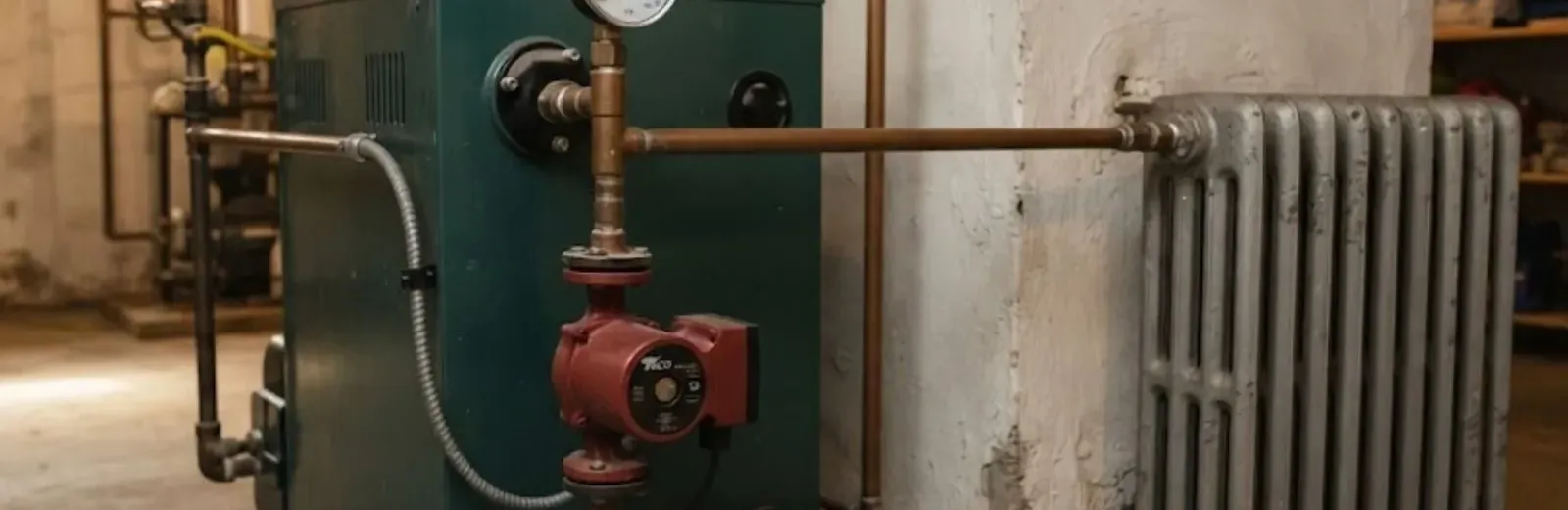
Vaillant is a boiler brand, and Vaillant boiler repair in Westfield, NJ usually starts with the same questions as any modern gas boiler: is it getting a heat call, is it getting power, is the system pressure in range, and can the condensate drain. Those are checks a homeowner can make without opening the cabinet. Anything beyond them belongs to a licensed heating contractor.
We handle the plumbing side of a heating system, such as leaking valves, piping, and expansion issues, and we will say plainly on the call when your problem is manufacturer-specific or involves the gas train. This guide skips model numbers and fault codes, since your manual and the unit's display are the right source.
If You Smell Gas, Do This Before Anything Else
PSE&G guidance is to leave the building immediately and move at least 350 feet away. Then call 1-800-880-PSEG (7734) or 911. Do not use light switches, doorbells, matches, appliances, or a phone inside the house, do not try to find or fix the leak, and do not start a car in the garage.
A gas smell is never a plumber's first call. Call the utility or 911 first, and call us afterward for any plumbing work the repair needs.
Why a Boiler Locks Out or Loses Pressure
A modern condensing gas boiler runs a safety routine each time it fires. If something in that routine fails, such as a missing flame signal, low water pressure, or a blocked condensate path, the control board locks the boiler out until it is reset or the cause is fixed. A lockout is the boiler protecting itself, not a random mood.
Pressure loss is a different symptom. A sealed heating loop holds water under modest pressure, and the gauge on the front or the display shows where it sits. A slow drop usually means water is going somewhere: a weeping valve, a leaking radiator vent, or a pressure relief valve that has started to drip.
Smell gas near the boiler?
Leave, move 350 feet away, then call PSE&G or 911. Call a plumber afterward.
Homeowner Checks in Order, Before Anyone Opens the Cabinet
Stop at the first sign of gas, water on electrical parts, or a part you cannot name.
- 1
Confirm the thermostat is calling for heat
Set it several degrees above room temperature in heat mode and check the batteries. A blank wall control is a common cause.
- 2
Check power at the boiler
Look for a lit display. Check the switch near the unit and the breaker. A tripped breaker that trips again right away is a stop sign, not a reset-and-hope situation.
- 3
Read the pressure gauge or display
Your manual states the normal range for a cold system. A reading near zero means the loop has lost water. A reading that climbs high when hot can mean a failing expansion vessel.
- 4
Look at the condensate drain
Condensing boilers drip acidic water into a trap and a drain line. A clogged line or a frozen outdoor run can shut the boiler down. Look for a backed-up trap or ice on the outside of a drain pipe.
- 5
Reset once, using the manual
A single reset is reasonable. If it locks out again, stop. Repeated resets stress components and hide the real fault.
Symptom, Likely Area, and Who Handles It
This sorts symptoms by area. It is a guide for questions, not a diagnosis.
| What you see | Area to suspect | Who usually fixes it |
|---|---|---|
| No heat, display dark | Power, switch, or breaker | Homeowner check first, then an electrician or heating contractor |
| Display lit, no heat, thermostat satisfied | Thermostat call or wiring | Homeowner check, then heating contractor |
| Lockout after ignition attempt | Flame, gas, or ignition parts | Licensed heating contractor |
| Pressure drops week after week | Leak at valve, vent, or fitting | Plumbing side: our team can look |
| Gurgling and shutdown in a cold snap | Condensate trap or drain | Homeowner check, then a pro if frozen or buried |
Manufacturer-specific repairs and gas train work are licensed heating work.
Where Our Work Ends and a Heating Contractor's Begins
We cover the water side: leaking shutoff valves, weeping fittings, heating piping, relief valve discharge lines, and expansion problems that show up as pressure swings. When the gauge keeps dropping, our boiler repair visits start by hunting for the leak, and a bad pipe or valve is often fixable on that visit.
Manufacturer-specific repairs, control board faults, burner and combustion work, and anything inside the gas train are done by a licensed heating contractor. We will say so on the call and will not send you a plumber to guess at a gas problem. New Jersey allows plumbing work only by a master plumber, an authorized plumbing contractor, or their employees, so ask any contractor for the license number and confirm it with the State Board.
Carbon Monoxide: What a Homeowner Should Do
Gas heating can produce carbon monoxide when venting or burning goes wrong. This is general safety advice, not a diagnosis.
Have working CO alarms
Put them on each floor and near sleeping areas. Check the test button on a schedule and replace units on the maker's timetable.
Know the alarm response
If a CO alarm sounds, get everyone outside into fresh air and call 911. Do not reset it and go back to bed.
Watch for the quiet signs
Headaches, nausea, or dizziness that clears when you leave the house, or soot at the boiler, are reasons to shut it down and call a heating professional.
Keep vents clear
Outdoor intake and exhaust terminals must stay free of snow, leaves, and nests. Look from the ground. Do not climb to check.
Older Westfield Homes and PSE&G's Gas Safety Rules
PSE&G serves gas customers in Westfield, and its guidance is to leave, move at least 350 feet away, and call 1-800-880-PSEG (7734) or 911 for a suspected leak. Write that number on a card near the boiler and tell every adult in the house, since the person who smells gas is not always the one who knows the plan.
About 37 percent of homes in ZIP 07090 were built in 1939 or earlier, and about 28 percent in 1940 to 1959, per US Census ACS data summaries. Older homes tend to have heating piping extended over decades. If your pressure keeps dropping, ask the technician to trace the whole loop, including old radiator valves in rooms rarely used.
Source type: utility safety guidance (PSE&G) and US Census ACS data
When to Stop and Call
Stop and call a professional if you smell gas, if the boiler locks out again after one reset, if you see water on or near electrical parts, if the pressure relief valve is discharging, or if the system needs frequent refilling. Frequent refilling can hide a leak that is damaging a floor below. Our 24/7 dispatch line is open for plumbing-side problems, and we will tell you if the boiler itself needs a heating contractor.
We also serve nearby towns, including Scotch Plains. If a leak under a boiler turns out to be a slow supply line, our leak detection work can find it before it reaches the ceiling below.
Boiler Questions From Westfield Homeowners
Some systems have a filling loop and the manual explains the steps. Add water only up to the stated pressure, and ask why it dropped. A system that needs topping up often has a leak.
Condensate lines can freeze outdoors and block the drain. The boiler then shuts itself off. Thawing an exposed run is a pro job if the pipe is split.
No. Codes and control board work are for a licensed heating contractor. We will tell you on the call if that is what your problem needs.
Do not cap or plug it. A dripping relief valve means the loop pressure got too high or the valve is worn. Shut the boiler off and call.
Not by itself. Older piping and radiators can work with a condensing boiler, but leaks, sludge, and old valves are more likely. A technician should check the loop.