

A plumbing vent is the pipe that runs from your drain lines up through the roof so air can enter behind moving water. To unclog a plumbing vent in Westfield, NJ, you first confirm the vent is the real problem, then clear the opening at the roof or push a cable up from below. Leaves, a nest, or ice can plug the top, and then every drain in the house has to fight a vacuum.
This guide covers the symptoms that point to a vent, the checks you can make safely from the ground, what a plumber does with a camera and cable, and the point where you should stay off the roof.
What the Vent Does, and Why a Plug Mimics a Clog
Water leaving a drain pulls air behind it, much like a finger over the top of a drinking straw. The vent stack lets outside air replace that volume. Without it, water drains slowly, and the trap under each fixture can be sucked dry or bubble as air forces through the seal.
That trap seal is also what keeps sewer gas out of the room. When a blocked vent empties a trap, the smell of sewer gas can drift out of a floor drain or a seldom-used bathroom sink. So a vent problem can look like a drain clog, a sewer problem, and a smell problem all at once.
Symptoms That Point Upward Instead of Down
One slow sink is usually its own trap. Look for a pattern.
Gurgling from a drain you did not use
You run the washing machine and the basement floor drain or a shower burps. Air is being pulled through the nearest water seal because the vent cannot supply it.
Slow drains on several fixtures at once
If the tub, the toilet, and a sink on the same branch all sluggishly drain, but a cable through each trap finds nothing, airflow is a better suspect than a clog.
Sewer smell with no wet spot
A dry trap lets gas rise. Pour water into the unused drain. If the smell returns within days, a vent or a leaking fitting may be the cause.
A toilet that glugs after flushing
The bowl refills with a gulp and bubbles. That is air rushing back through the trap.
Gurgling at more than one drain?
A blocked vent is a common cause. Do not climb a wet or icy roof to check.
Vent Problem or Drain Clog: A Quick Sorting Table
Use this to decide where to look first.
| What you notice | More likely a vent | More likely a drain clog |
|---|---|---|
| One sink drains slowly | Rare | Common: hair, soap, or grease in the trap |
| Several fixtures gurgle together | Common | Possible if the main line is partly blocked |
| Water backs up in the lowest drain | Less common | Common: main line or sewer lateral |
| Problem appears after a storm or wind | Common: limbs, leaves, or a nest | Less common |
| Sewer smell but drains run normally | Possible | Possible: dry trap or leaking joint |
A table narrows the search. Only a camera or a cable test confirms the answer.
Checks You Can Make From the Ground
These take a few minutes and carry little risk. Stop if a step needs a ladder.
- 1
Run water at one fixture and listen
Fill the sink, then pull the plug. A steady swirl is normal. A gulping sound or bubbles in a neighbor fixture means air is moving the wrong way.
- 2
Find the vent terminal from the yard
Stand back and look at the roof. The vent stack is usually a pipe poking up near the ridge or back slope. Binoculars help. Look for a nest, a mat of leaves, or ice on the opening.
- 3
Check the trap seal at the quiet drains
Pour a quart of water into the floor drain and any guest bath fixture. A dry trap explains a smell on its own and does not prove a vent fault.
- 4
Compare floors
If upstairs fixtures gurgle but the basement does not, the blockage is probably in a branch vent near the upper bath. If every floor complains, suspect the main stack.
Roof Safety: The Part Where the Answer Is No
Do not climb a wet, frosty, or iced roof, and do not go up in wind or on a steep pitch without fall protection. A vent job is not worth a fall. If the stack cannot be reached from a ladder on firm ground, leave it for someone equipped to work at height.
Never run a garden hose down a stack. Water forced into a blocked stack can overflow a trap inside the house.
What a Plumber Does Once the Vent Is the Suspect
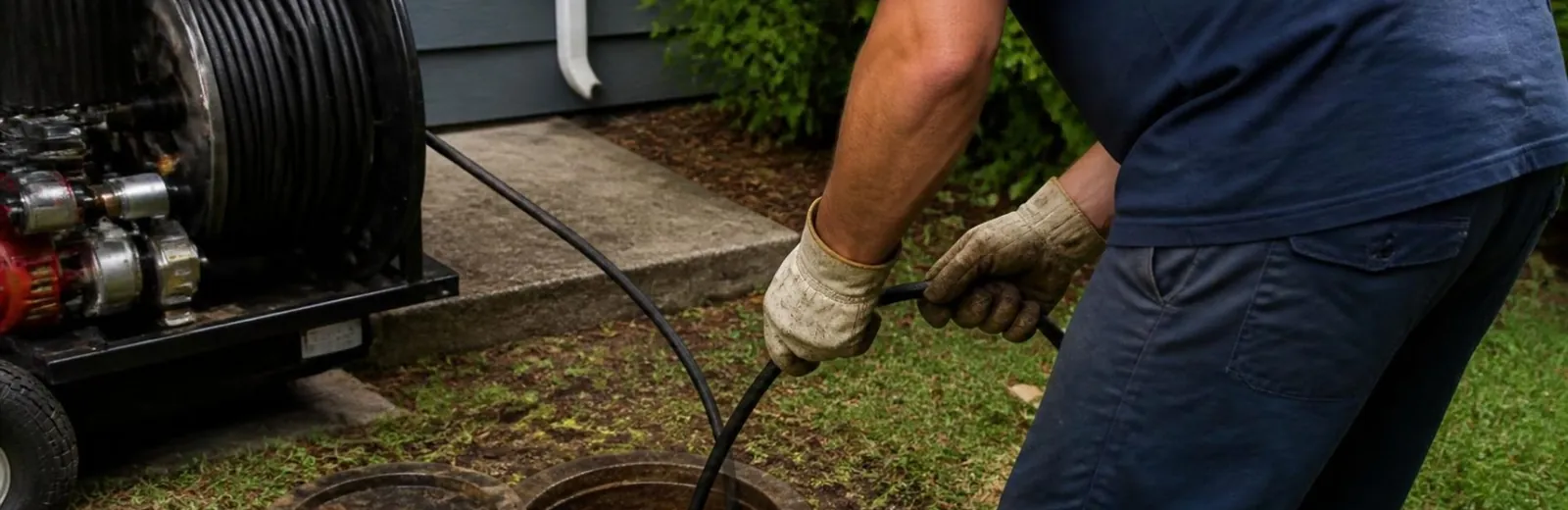
The first step is to confirm the vent is blocked and not a cracked pipe inside a wall. A small camera on a flexible cable can be fed down from the roof opening, or up through a cleanout, to find the obstruction. Debris, ice, or a nest usually sits at the terminal, while rust scale can narrow an old galvanized stack lower down.
Clearing is done with a cable or a small water jet fed from the roof, with the drain side watched so nothing overflows. For a heavy plug in a long branch, a jetting nozzle through a cleanout may beat going up.
Afterward we run water at every fixture and listen for the gurgle. Replacing a failing section is a licensed repair, not a cleaning job. For the drain side, see our drain cleaning service, and for the pipe interior, a camera inspection shows what a cable cannot.
Westfield's Pre-War Roofs and a Willow Grove Road Reminder
About 37 percent of homes in ZIP 07090 were built in 1939 or earlier, and the median build year is about 1953, according to US Census ACS data. Older houses often have vents rerouted during later bathroom additions, so the pipe you see at the roof may not be the only one. Ask whoever works on yours to trace every terminal.
Westfield's Historic Preservation Master Plan, adopted April 1, 2024, identifies districts such as Wychwood, Dudley Park, and Prospect Street. If your home sits in one, ask the Westfield construction office before roof work that changes how the vent looks.
In a July 2025 storm, a lightning-struck limb closed Willow Grove Road after it brought down a power line. Limbs and leaves reach roofs in the same storms, and a vent near a mature tree is where a plug appears first. If gurgling starts after weather like that, look at the opening from the ground before blaming the main line.
Source type: US Census ACS data and newspaper storm coverage
When to Call a Pro, and Where Your Limit Is
Call when the roof is steep, wet, or icy, when more than one floor is affected, when a sewer smell lingers, or when water backs up into a tub or floor drain. Backup means the line below is blocked too. A stack behind finished walls is not a homeowner task.
In New Jersey, plumbing work may be performed only by a master plumber, an authorized plumbing contractor, or their employees. Cleaning leaves from an opening you can reach from the ground is housekeeping. Cutting into a stack, re-running a vent, or altering piping is plumbing. Our 24/7 dispatch line can sort which one you have, and we also serve neighbors in Scotch Plains and across the area.
Vent Questions Homeowners Ask
It can cause slow flushing and gurgling. A true backup of waste into the bowl usually points to a blocked drain line, though a vent plug can make a partial blockage worse.
Sewer blockages push water up from the lowest drain, often the basement floor drain or a first-floor tub. Vent blockages produce noise and slow draining without the water coming back up.
No fixed schedule exists. Look at the terminal after storms, high wind, and hard freezes, from the ground, and clear problems when symptoms show up.
Often, yes. Decades of bathroom additions can leave unusual vent routing. A camera helps map it before anyone opens a wall.
Our dispatch line runs 24/7, and same-day appointments are available when possible. If sewage is backing into the house, call right away and keep clear of the water.