

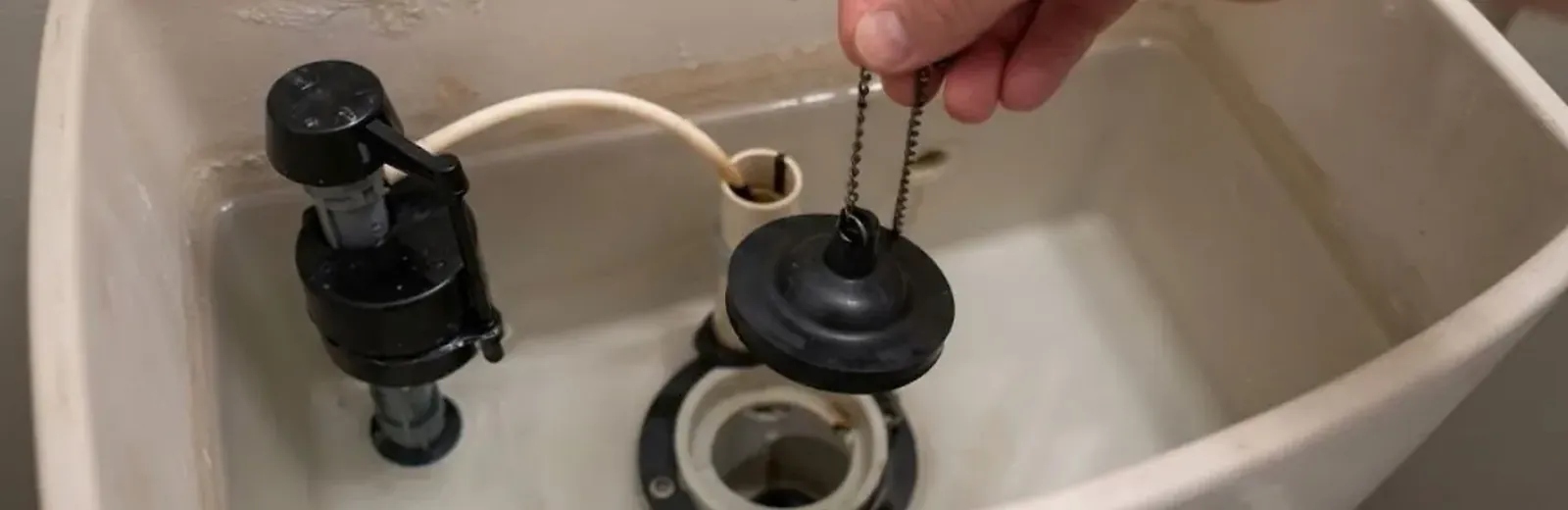
To repair a leaking toilet tank in Westfield, NJ, you first work out where the water is escaping: from the tank to the floor, from the tank into the bowl, or only as condensation on the outside. A toilet tank is the ceramic reservoir behind the bowl that holds a flush of water, and it leaks at its bolts, its supply connection, its flapper seat or through a crack.
Some of these are quick owner fixes and some mean the tank or toilet should be replaced. Start with the dye test below, because it separates a silent internal leak from a visible one in about 15 minutes, and then match what you find to the repair.
The Dye Test That Finds a Silent Leak
A running tank that leaks into the bowl rarely makes obvious noise. This test catches it.
- 1
Dry the outside first
Wipe the tank and base so that any new water you see afterward is real, not old drips.
- 2
Add color to the tank
Drop a few drops of food coloring or a dye tablet into the tank water. Do not flush.
- 3
Wait and watch the bowl
After 15 minutes, look at the bowl. Color showing up means the flapper or its seat is leaking into the bowl.
- 4
Check the outside for beads of water
Dry the tank again with a paper towel. If drops return only in humid weather and are colorless, it is condensation, not a leak.
- 5
Check the base and bolts
Put a dry paper towel under the tank bolts and at the supply connection. Colored water on the towel points to the exact joint.
Where It Leaks, Why, and What Fixes It
| Where the water shows | Likely cause | Typical repair |
|---|---|---|
| Under the tank around the bolts | Worn rubber washers on tank-to-bowl bolts | Replace bolts and washers as a set, snug evenly |
| Bowl sits dry but water slowly refills | Warped or dirty flapper, or a chain with no slack | Replace flapper, set chain slack |
| Hissing, water keeps trickling into the overflow tube | Failed fill valve or float set too high | Replace the fill valve or lower the float |
| Drip at the supply line joint | Loose or worn coupling nut or washer | Replace the supply line and gasket |
| Water beads on the outside of the tank | Condensation from cold water in warm air | Insulate, ventilate, or fit a tank liner if desired |
| Hairline crack in porcelain | Impact or freeze damage | Replace the tank or the toilet. Crack repairs are temporary |
Dye in the bowl with no wet floor means a flapper issue. A wet floor with a dry bowl means look at the bolts and supply.
Puddle spreading now?
Close the oval valve behind the toilet by turning it clockwise, then mop up and call.
The Water Bill Is the Other Clue
A toilet that leaks into the bowl can waste a surprising amount of water without any noise, and the first sign is often a bill that has crept up with no change in habits. Check your meter with every tap and appliance off. If the leak indicator or the dial keeps moving, the water is going somewhere, and the toilet is one of the first places to look.
If the dye test is clean and the meter still moves, the leak is elsewhere: a supply line, a hose bib, or a pipe in a wall or slab. That is when leak detection with listening gear and a moisture meter earns its keep.
Old Westfield Bathrooms and Reading Your Meter
Census American Community Survey data shows about 37 percent of homes in ZIP 07090 were built in 1939 or earlier and the median year built is about 1953. Original bathrooms in those houses often have old fill valves, brittle supply lines and shutoff valves that seize. Test your shutoff valve before a leak makes you need it, and have a plumber replace one that will not turn smoothly.
Ask your water utility how to read your meter and your bill for a silent leak. Utilities can usually explain the leak indicator on your meter and what a rise in usage looks like. We do not know your account details, so that call to the utility is the quickest way to tie an unexplained bill to the toilet.
Source type: US Census ACS housing data
What a Homeowner Can Safely Check
These checks need no tools beyond a screwdriver and a towel.
- Lift the lid and look at the water level against the mark on the overflow tube or tank
- Press the flapper down by hand. If the hiss stops, the flapper or seat is the problem
- Look at the chain. Too tight holds the flapper open, too loose tangles it
- Feel under the tank bolts and the supply joint with a dry paper towel
- Rock the toilet gently. Movement means loose floor bolts, which need a pro to check the flange
- Close the shutoff valve and see whether it holds, then reopen slowly
When to Stop and Call a Plumber
Swapping a flapper, adjusting a float or replacing a supply line are tasks many owners handle. Anything involving a cracked tank, a rocking toilet, a seized shutoff valve or water coming from the floor around the base needs a licensed plumber, since state law limits plumbing work to a master plumber, an authorized plumbing contractor, or their employees. Call our 24/7 dispatch line if water is reaching the floor or the ceiling below.
Our toilet repair and installation visits bring the common parts, and we also serve Scotch Plains, as described on the Scotch Plains page.
Leaking Toilet Tank Questions
No. Sweat is colorless water from humid air condensing on a cold tank, usually in summer. A leak keeps going in dry weather and will show dye in the water if you test it.
Epoxy may slow a seep, but a cracked tank can fail without warning, so treat it as a short-term patch while you replace it.
Snug and even, alternating sides. Over-tightening cracks the porcelain, which turns a gasket problem into a new tank.
It depends on the tank condition and parts availability. A sound tank usually takes a new fill valve and flapper well. Heavy staining, cracks or a stuck shutoff favor replacement.
Dry everything, tape a paper towel to the floor at the base, and flush a few times. If the towel stays dry but the bolts drip, the tank is the source. If the base is wet, the wax ring is suspect.
Yes, especially a leak into the bowl that never makes a sound. Ask your water utility how to read the meter and bill for a silent leak.