
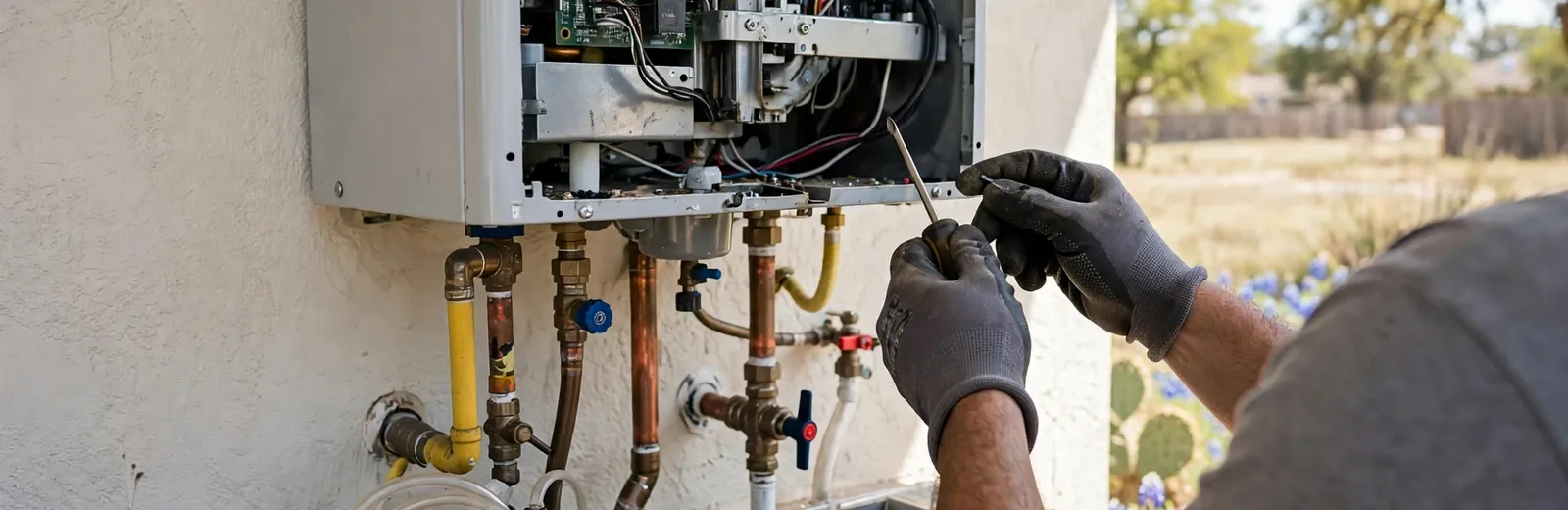
To flush a tankless water heater in Westfield, NJ, you circulate a mild acid, usually white vinegar, through the unit's heat exchanger so that mineral scale dissolves, then rinse it with clean water. A tankless heater is a wall-mounted gas or electric unit that heats water only while a tap is open, and scale on its small internal passages is the main thing that wears down its performance.
Below you will find the signs that a flush is due, the owner-level steps in plain terms, and the situations where you should not attempt it. Always follow the manual for your exact model, because flush connections and run times differ between makers.
Signs the Heat Exchanger Is Scaling Up
Scale builds slowly, so the symptoms creep in over months. Hard water, a unit that has never been serviced, and years of constant use all speed it along.
Water runs lukewarm at full flow
Scale insulates the exchanger, so the unit cannot hand off its full heat to the water passing through.
Temperature swings mid-shower
Restricted passages make the unit cycle on and off as it tries to hold a setpoint.
Flow seems weaker than before
Mineral flakes can narrow the small channels and clog the inlet screen.
An error code returns after resets
Many units flag overheating or flow problems when scale gets heavy. Look the code up before assuming scale.
Rumbling or popping from the unit
Steam pockets form under deposits and make noise as water heats unevenly.
The Flush Sequence, Step by Step
This is the general order most manuals follow. Your manual wins if it differs.
- 1
Shut off the fuel and power
Close the gas shutoff to the unit and switch off the electrical supply, or unplug it, so the burner cannot fire while it is full of vinegar.
- 2
Close the isolation valves
Flush-ready installs have a service valve pair on the hot and cold lines, each with a small purge port. Closing the main valves isolates the heater from the house.
- 3
Connect hoses to a small pump and bucket
A submersible pump pushes the vinegar through the unit from one purge port, and a second hose returns it to the bucket.
- 4
Circulate the vinegar for the manual's time
Run it for the time stated in your manual. Heavy scale usually needs longer than light scale.
- 5
Rinse and clean the screen
Flush with clean water until the smell of vinegar is gone, then clean the cold-water inlet screen of loose flakes.
- 6
Reopen valves and restore fuel
Open each valve slowly, bleed air at a hot tap, then restore power and gas and test for steady temperature.
Error code on the display?
Scale is a common cause, but a code can also mean a gas or vent fault. Check the manual before anything else.
Do It Yourself or Hand It Off?
| Situation | Owner can try | Call a plumber |
|---|---|---|
| Isolation valves already installed | Flush per the manual if comfortable | If valves stick, drip or will not close |
| No isolation valves on the unit | Do not cut into pipes | A plumber must add valves before a flush can be done |
| Smell of gas near the unit | Nothing. Leave the house | After PSE&G or 911 clears it, call us |
| Error code returns right after a flush | Recheck connections and the inlet screen once | Heat exchanger, flame or vent fault is possible |
| Unit is cramped, high on the wall or in a tight closet | Skip it | Safer with a plumber and proper access |
| Water is leaking from the unit or fittings | Close valves and stop | Leaks inside the cabinet need professional repair |
A flush is maintenance. Adding valves, changing gas piping or touching the vent is licensed plumbing work.
Westfield Tap Water and the Sediment Screen
How fast scale forms depends on your tap water. New Jersey American Water supplies Westfield, and the practical move is to buy a hardness test kit and check your own tap, then ask the utility for its latest water quality report. Harder water means you should look at the flush interval in the manual more often than the minimum.
A water main break on East Broad Street in December 2020 shut the road, affected about 20 commercial and 30 residential customers, and required roughly 16 hours of repair. Main work of that kind can stir sediment loose in nearby pipes. If your tankless heater starts spitting grit or its flow drops after street work on your block, clean the inlet sediment screen first.
Source type: utility press release plus ask-your-utility guidance
When Not to Flush It Yourself
Skip the DIY flush if the unit has no isolation valves, shows a flame or ignition fault, smells of gas, or sits where you cannot reach the ports safely. New Jersey allows plumbing work to be performed only by a master plumber, an authorized plumbing contractor, or their employees, so cutting in valves or changing piping is not a weekend task.
If the unit is losing heat even after a good flush, the cause may be a failing sensor, a vent problem or a failed heat exchanger. Our water heater repair team can diagnose it, and a worn-out unit may be better swapped for a new tankless water heater, and you can call the 24/7 dispatch line if the heater has quit entirely.
We also reach Scotch Plains homes, so the Scotch Plains page has details on that side of the border.
Tankless Flush Questions
Follow the interval in your manual. Hard water shortens the gap, so a home with a high test-kit reading should flush more often than the baseline.
Most makers allow food-grade white vinegar for descaling, but a few specify their own solution. Check your manual before you buy anything.
Not safely. Without service valves, a plumber has to add them first, and that is licensed work.
Run a hot tap to clear debris, then clean the cold inlet screen. If the grit keeps coming or flow stays weak, call for a check.
Sometimes, when scale is the cause. A shutoff that persists after a flush points to flow, flame or sensor trouble and needs a technician.
A flush is maintenance, so it is usually not a permit question, but installing or changing a unit is different. Ask the Westfield construction office before any work that alters piping or venting.