

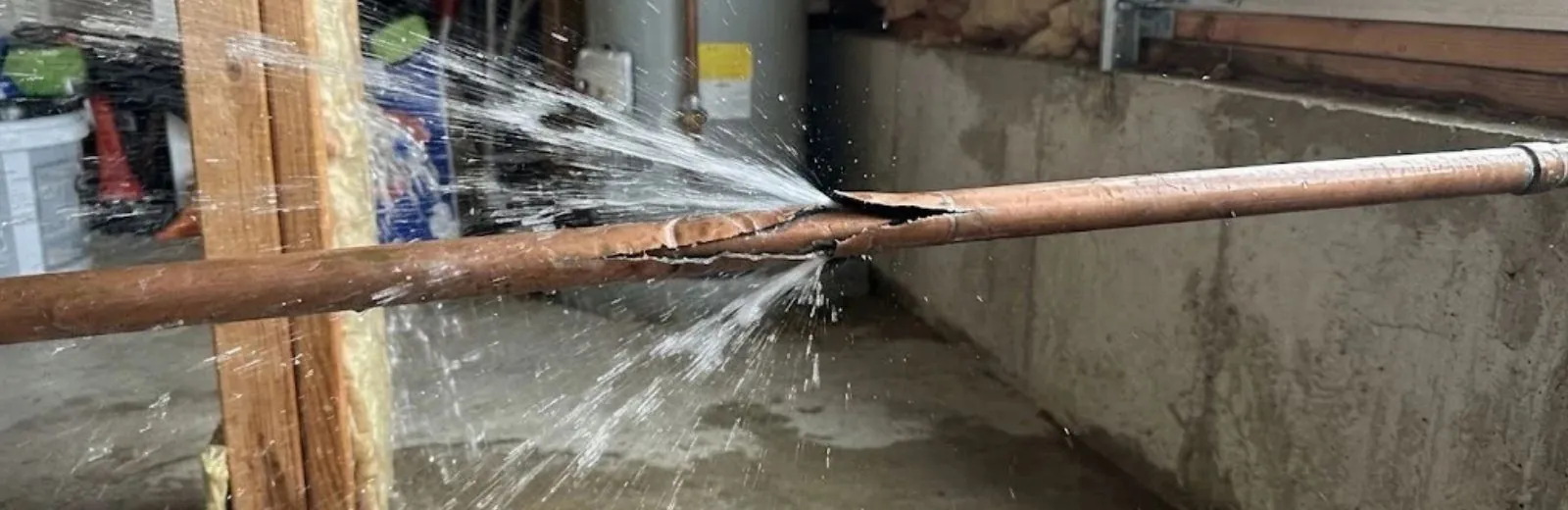
If you suspect frozen pipes in Westfield, NJ, open the faucet nearest the problem, find where the pipe is frozen, and warm that section slowly with a hair dryer or warm towels. Never use an open flame. Ice itself rarely bursts a pipe where it forms, since the damage often comes from pressure trapped between the ice and a closed faucet.
The steps below cover finding the frozen section, thawing it safely, telling a frozen pipe from a burst one, where the shutoff is, and how to prevent a repeat. The last section marks the point where thawing stops and a plumber starts.
The First Ten Minutes, in Order
Do these before warming anything. They limit damage if the pipe has already cracked.
- 1
Open the faucet nearest the frozen pipe
Open both hot and cold slightly. As the ice melts, water and pressure need somewhere to go. A dripping faucet also helps ice melt.
- 2
Find the main shutoff
Know where it is before you need it, usually near the meter or where the supply enters the basement. Check that it turns.
- 3
Locate the frozen section
Feel along exposed pipes for a cold stretch with frost on it. Pipes along exterior walls, in crawl spaces, and near basement windows freeze first.
- 4
Check for cracks or bulges
Look for splits, bulges, or damp insulation. If you see one, close the main and call. Do not thaw a pipe that already looks damaged.
- 5
Warm the section slowly
Use a hair dryer on low, warm towels, or a heating pad, working from the faucet end toward the frozen part.
Safety Rules for Thawing
Never use a torch, a propane heater, a heat gun on high, or any open flame. Soldered joints can melt, old walls and insulation can ignite, and a fire in a wall may go unseen. Never use a device that could touch standing water, and keep an extinguisher in reach if a heater is nearby.
If you cannot find the frozen spot, if it lies behind a finished wall, or if the pipe is split, stop. Let a plumber handle it.
See water where it should not be?
Shut the main valve first, then call. A thawed crack can flood fast.
Frozen, Burst, or Something Else
The signs overlap. This table helps you sort what you see.
| What you notice | Likely cause | Your next move |
|---|---|---|
| No water at one faucet, others fine | Frozen branch line | Open faucet, warm the section |
| No water anywhere, no sound | Frozen main or meter area | Check the meter area, call if you cannot thaw it |
| Trickle that fades | Partial freeze | Warm the pipe, keep faucet dripping |
| Wet drywall, stain, or hissing | Burst or cracked pipe | Close the main, call at once |
| Water flows after thaw, then leaks | Pipe split by the ice | Close the main, call a plumber |
| Neighbors also have no water | Utility main problem | Call the water utility, not a plumber first |
A burst pipe often shows itself only when the ice melts and flow resumes.
If the Pipe Has Burst
Close the main shutoff, then open the lowest faucet to drain the lines. If water is near the electrical panel or an outlet, do not enter, and call 911 or the electric utility. Take photos of damage for your insurer, move belongings, and call us.
Our burst pipe repair visits begin by finding the split, drying access, and cutting out the damaged section. A pipe that froze once is a candidate for the same failure again, so we also look for the cold spot that caused it.
Prevention Before the Next Cold Snap
These steps cost little and work best before the freeze, not during it.
- Insulate pipes in crawl spaces, garages, and along exterior walls with foam sleeves
- Keep the heat on, even in a room you rarely use
- Let a faucet drip on the coldest nights, especially one at the far end of an exposed run
- Open cabinet doors under sinks on exterior walls so room heat reaches the pipes
- Disconnect hoses and close the interior valve to outdoor spigots
- Seal gaps where pipes pass through walls, with caulk or foam
- Know where your main shutoff is and test the handle each fall
Older Westfield Walls, Historic Districts, and the East Broad Street Main Break
About 37 percent of homes in ZIP 07090 were built in 1939 or earlier, and about 28 percent in 1940 to 1959, per US Census ACS data. Older houses often have little insulation in exterior walls and unconditioned crawl spaces, which leaves supply pipes exposed. If you live in one, walk the crawl space in fall, wrap exposed pipes, and seal gaps.
The town's Historic Preservation Master Plan, adopted April 1, 2024, identifies districts such as Stoneleigh Park, Westfield Gardens, and Brightwood Park. If your home is in one, ask the Westfield construction office before altering exterior walls or trim, since wall work may need review.
A New Jersey American Water main break on December 12, 2020, near 126 East Broad Street, affected about 50 customers. It shows what a main failure looks like: several neighbors lose water together. If your street is dry, call the utility. If only your house is dry, look at your own pipes.
Source type: US Census ACS data and utility press release
When to Stop Thawing and Call
Call a plumber when the frozen section is inside a wall or under a slab, when you see a crack or bulge, when thawing has not worked after a reasonable try, or when water appears where it should not. Under New Jersey's licensing rule, cutting out a split section is licensed work.
Our 24/7 dispatch line is open on cold nights. We serve Scotch Plains and Westfield, and a frozen line that has cracked is also what our leak detection work finds when the damage is behind a wall.
Frozen Pipe Questions
Yes. Open water gives melting ice and trapped pressure a way out, and running water helps the thaw.
Aim a small heater at an exposed pipe only from a safe distance and keep it away from standing water and combustibles. Never leave it unattended.
Look for wet spots, stains, or hissing. A pipe may only leak once the ice melts, so check again after flow returns.
If you drained the lines, switch the heater off first and let the tank refill before turning it back on. A heater firing on an empty tank can be damaged.
It can be, since older exterior walls and crawl spaces tend to have less insulation. Wrap exposed pipes and seal gaps.
Policies often cover sudden accidental discharge but not wear or slow seepage. Read your policy and photograph the damage.